




There is a hilltop near the San Justo Reservoir with an impressive panoramic view of Hollister. There is something equally impressive on the hill that is less obvious: a buried storage tank that holds up to 500,000 gallons of clean water that feeds into the houses, businesses, ranches and farms below.
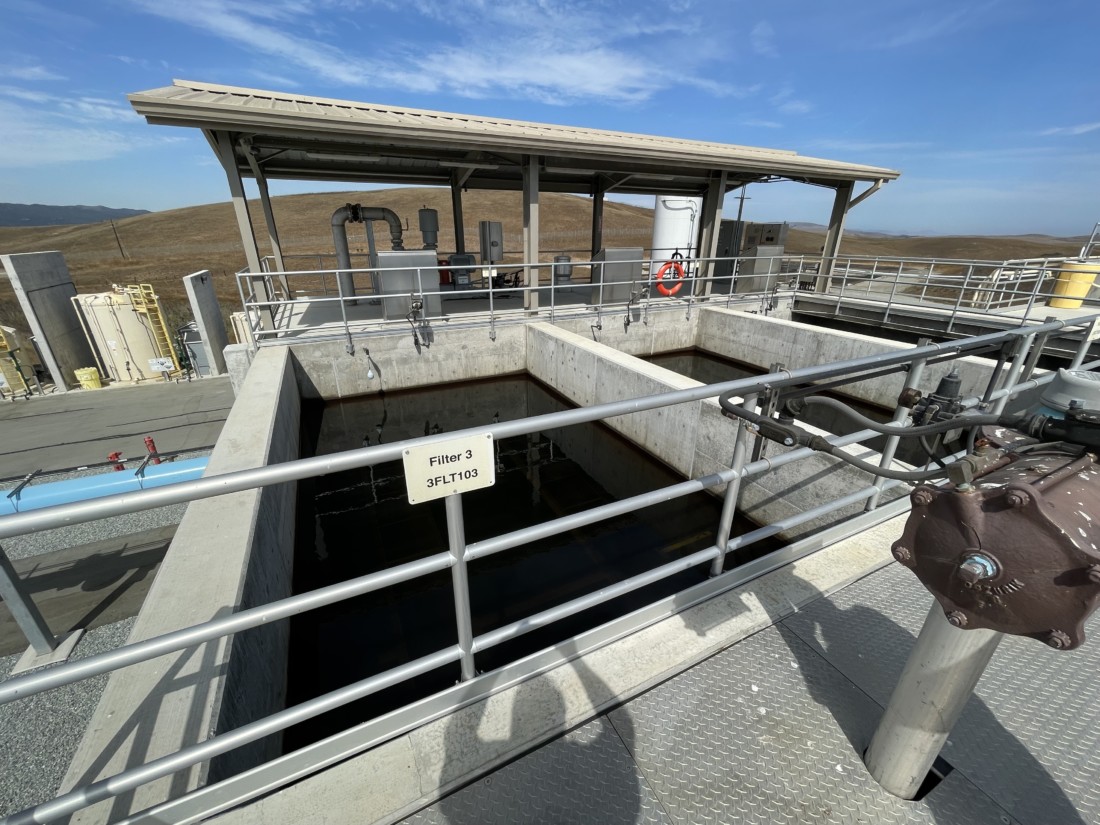
It sits next to the West Hills Water Treatment Plant, which filters and processes clear, clean, balanced water for Hollister’s residential and commercial use.
The plant, completed in 2017, is part of the Hollister Urban Area Water Project—a key element in the expansion of the city.
It can treat 4.5 million gallons of water a day, which the San Benito County Water District (SBCWD) estimates will meet customer needs through 2025, enough for an average family of four to get 440 gallons of water per day. The plant can be expanded to treat up to 9 million gallons a day.
The plant currently runs at about half of its current capacity. According to treatment operator Troy Quick, the district is treating 2.2 million gallons a day, which works out to a little over 1,400 gallons a minute.
The water coming to the plant, called “surface water,” starts as snow runoff from the Sierra Nevada and Cascade mountains that is diverted to the San Luis and San Justo Reservoirs.
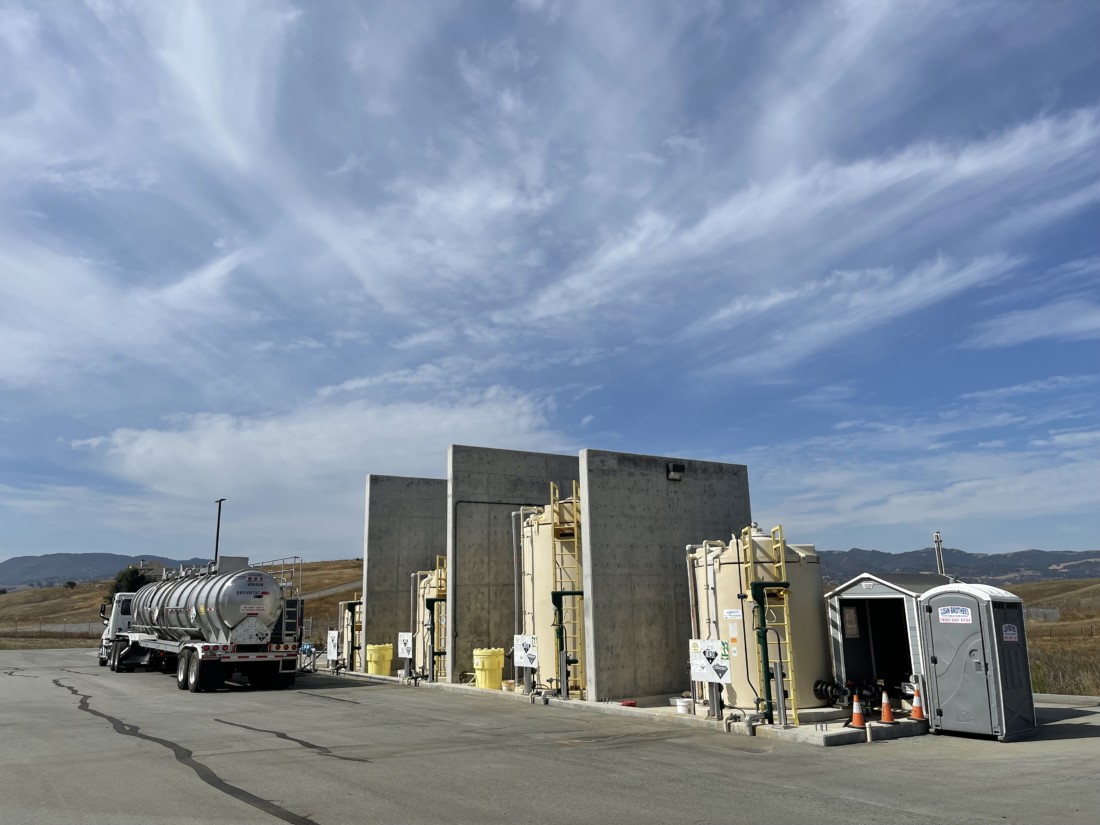
The water is relatively clean on arrival, needing only a nudge in the right direction to become drinkable water. It starts with the addition of various chemicals to prepare the water for filtration.
“For the plant to work optimally, we use sulphuric acid to drive the pH level down,” said Quick. “We add a polymer and a coagulant that clump up the solids and settles them out. Then we have a caustic to bring the pH level back up and chlorine for disinfection.”
A pH level is a measure of acidity on a scale of 0-14, with a rating of 7 being neutral. John Freeman, a San Juan Bautista City Council member and specialist on industrial water treatment, said the water from the plant ends up at a range between 7.8 to 8 to safeguard pipes from corrosion.
After this initial treatment, the water is diverted through a filter.
“We have a new state-of-the-art filtration system called Actiflo,” said treatment operator Billy Boltz. “That settling process does most of the work before it goes on to the filters. Then we run it through the filters to finish it off.”
The clarity of water is measured by Nephelometric Turbidity Units (NTU), which is based on the amount of light scattered by particles in water. The state standard is 0.3 NTU and, according to Boltz, the plant regularly exceeds that standard, reaching 0.03 NTU.
“The processed water is like snowmelt, very pure water,” said Shawn Novack, director of the Water Resources Association of San Benito County. “We then blend it with groundwater to reduce the hardness and it makes good quality water for everyone to drink. And what excites me is that it also makes good quality wastewater. It can be sent out to the reclamation plant, cleaned up, and used again for farmers and landscape accounts. For every gallon we bring in, we can use it twice.”
The water from West Hills is much less hard than the well water, which spawned a water softener buyback program in Hollister. With around 5,000 water softeners in the city, the program has purchased back over 1,200 of them. Novack hopes to extend the program to San Juan Bautista.
In February, San Juan Bautista City Manager Don Reynolds negotiated a memorandum of understanding with the Water District to help supply the city with enough water from West Hills to help with the problem of the high-nitrate well water currently in use.
With only 5% of Hollister’s population, San Juan Bautista’s water needs are comparatively small and plant operators estimated the city might need to import about 360,000 gallons a day. Reynolds told BenitoLink the calculation depends on how much plant water it takes to blend with the existing supply of well water to produce a good final product, suggesting the plant might provide around 60% of the city’s needs.
“I am very hopeful that it will work out for us,” said Freeman. “Our need for water is not very big and the plant can easily handle it. It would not even make a dent in what they do. And we will have better quality water for everyone.”
We need your help. Support local, independent news. BenitoLink is a nonprofit news website that reports on San Benito County. Our team is committed to this community and providing essential, accurate information to our fellow residents. It is expensive to produce local news and community support is what keeps the news flowing. Please consider supporting BenitoLink, San Benito County’s news.
You must be logged in to post a comment.