

Lea este artículo en español aquí.
On the morning of Aug. 3, Bureau of Land Management biologist Mike Westphal came upon a dead American badger struck by a car on San Benito Street near Hollister High School.
That, it turns out, is not as unusual as it seems. The badger (Taxidea taxus) likely came up from the San Benito riverbed area before being struck. However, knowing it is a species of special concern in California, Westphal said he wanted to make the public aware that badgers and other animals are often on roadways at night where they cannot be easily seen.
According to Kristen Ahrens of UC Davis and the California Department of Fish and Wildlife (CDFW), the American badger is listed as a “species of special concern and a species of greatest conservation need” in the state.
However, the Central Coast area supports a healthy population and San Benito County is a hotspot. Ahrens said they can be found near urban areas when there are natural corridors such as rivers. Other areas where they can be found are near Hwy 101 and Hwy 25.

Ahrens said she is undertaking genetic studies of the species for CDFW and has been collecting road kill and other samples to study gene flow. She said she is looking at how urban roads can interfere with dispersal and finding mates, which can lead to a decrease in genetic diversity and an increase in inbreeding.
The research is still in the preliminary stage, Ahrens said. She added that information about the number of roadkill in certain areas and evidence of lower gene flow could help pinpoint where wildlife crossings could be most beneficial.
Ahrens asks that anyone spotting a badger report the sighting to the CDFW. This allows the agency to get more information for the study and enables the public to take part in a small way. Sightings can also be reported on iNaturalist.
According to the CDFW and the National Park Service:
- Measuring between 23.5 and 29.5 inches in length, male badgers are slightly larger than females. The average weight is 14 to 16 pounds for females and up to 19 pounds for males.
- Living in burrows, they use their long claws to dig. They also use their digging technique to prey on small burrowing mammals such as ground squirrels and gophers.
- Except for the head, the American badger is covered with a grizzled, brown, black and white coat of coarse hair or fur, reflecting a mixed brown-tan appearance. Its triangular face shows a distinctive black and white pattern, with brown or blackish “badges” marking the cheeks and a white stripe extending from the nose to the base of the head.
- Badgers are generally nocturnal or crepuscular (active at dawn and dusk), though they can be seen during the day or at twilight. They do not hibernate but can become less active in winter. Badgers can spend much of the winter in cycles of torpor that last around 29 hours.

Though interspecies collaboration is rare in wildlife, the U.S. Fish and Wildlife Service reports this species is often seen hunting in concert with the coyote (Canis latrans). Researchers have found that the coyote benefits by an increased catch rate of about 33% as a result.
According to research, this partnership works because of the different hunting styles of the predators and how their prey reacts to them. A ground squirrel, upon spotting a coyote, will crawl into its hole to escape. Upon seeing a badger, the ground squirrel will climb out of its hole and use its speed to outrun the badger. Hunting in tandem raises the prey’s vulnerability, benefiting both predators.
However, according to Ahrens, coyotes could also prey on young badgers.
Westphal said he advises people to slow down on local roads, noting that many nocturnal and crepuscular animals are hard to see until drivers are nearly on top of them such that, when traveling at high speeds, hitting them cannot be avoided.
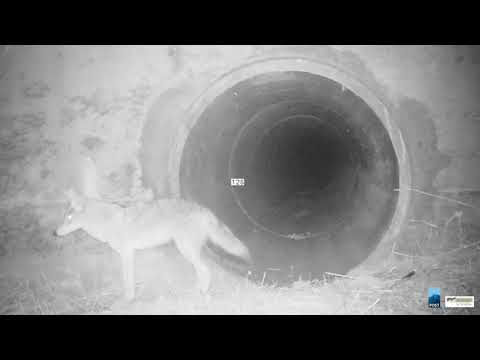
Video by Peninsula Open Space Trust used with permission.
We need your help. Support local, nonprofit news! BenitoLink is a nonprofit news website that reports on San Benito County. Our team is committed to this community and providing essential, accurate information to our fellow residents. Producing local news is expensive, and community support keeps the news flowing. Please consider supporting BenitoLink, San Benito County’s public service nonprofit news.
You must be logged in to post a comment.