

One of the best-kept secrets about San Benito County is the number of wineries all over the state that use grapes grown here to make their fine wines. As a perfect growing area for pinot noirs, chardonnays, cabernets, and just about any other kind of grape, the local wineries might sell as much as 90% of the harvest from their vineyards to winemakers from Los Angeles to Napa and Sonoma.
Comanche Cellars in Monterey sources many of their grapes from Siletto Family Vineyards in Tres Pinos and that vineyard’s remarkable quality and variety shine through in the wines that Comanche produces.
“I love San Benito County,” said Comanche owner Michael Simons. “What I am looking for in San Benito is what I can’t find anywhere else. You can find negrette and greco di tufo and sagrantino, grapes that don’t exist anywhere else. I love it because it gives us a chance to really expand our portfolio of wines and use those grapes in blends.”
Simons’ interest in winemaking dates back to his years at California Polytechnic State University, where he went to study horticulture in 1969.
“I have been in love with wine my whole life but back then wine itself did not seem to have any life to it,” Simons said. “I would go to the store and see a thousand different bottles, take one home, and it would usually be unimpressive. But that is what was available to me.”
In the early 2000s, a program started at Carmel’s Rancho Cellars, under owner Jacque Melac, where different winemakers would be featured in a weekly food and wine pairing.
“I started going and it was like the world opened,” he said. “That is where I really started learning about wine. I met other winemakers and I would go to their places and help make wine. I decided I was too old to start my own vineyard but I could still make wine myself.”
Simons began making wine in his basement in Monterey, starting with pinot noir.
“I was so excited,” he said. “I brought the grapes home and did all the things you do and three weeks later it was in barrels. I was crestfallen, like ‘what, this is it?’ All you can do after that is wait. So I went out and got some more grapes, some chardonnay, and made that as well. I ended up with four barrels that year.”
The next year saw Simons producing nine barrels, with 18 the year after and 30 the year after that. “I thought, ‘I’m going to go broke here, making all of this wine and giving it all away,’” he said. “I started selling and creating the business in 2007. I went through three wholesalers and brokers before I met Christina Cohen and she became my director of sales. She has never sold wine before but she was able to sell wine for me.”
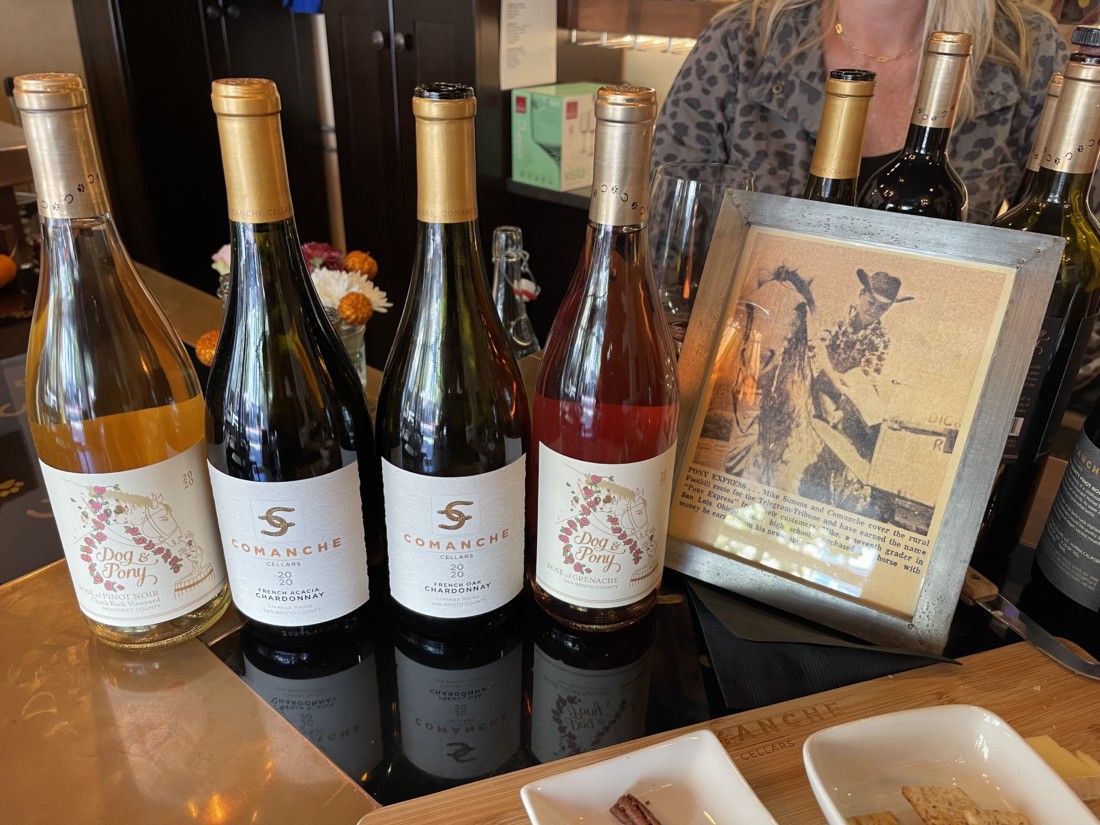
Simons named the winery after a horse he had in his youth, and he was known for using Comanche to help him deliver newspapers.
Simons expanded into opening his own tasting room in 2016, located in downtown Monterey at 412 Alvarado Street.
“We have created this great space where people like to come,” Cohen said. “We are open late, till 8 or 9 o’clock, so people can come and relax in the evenings.”
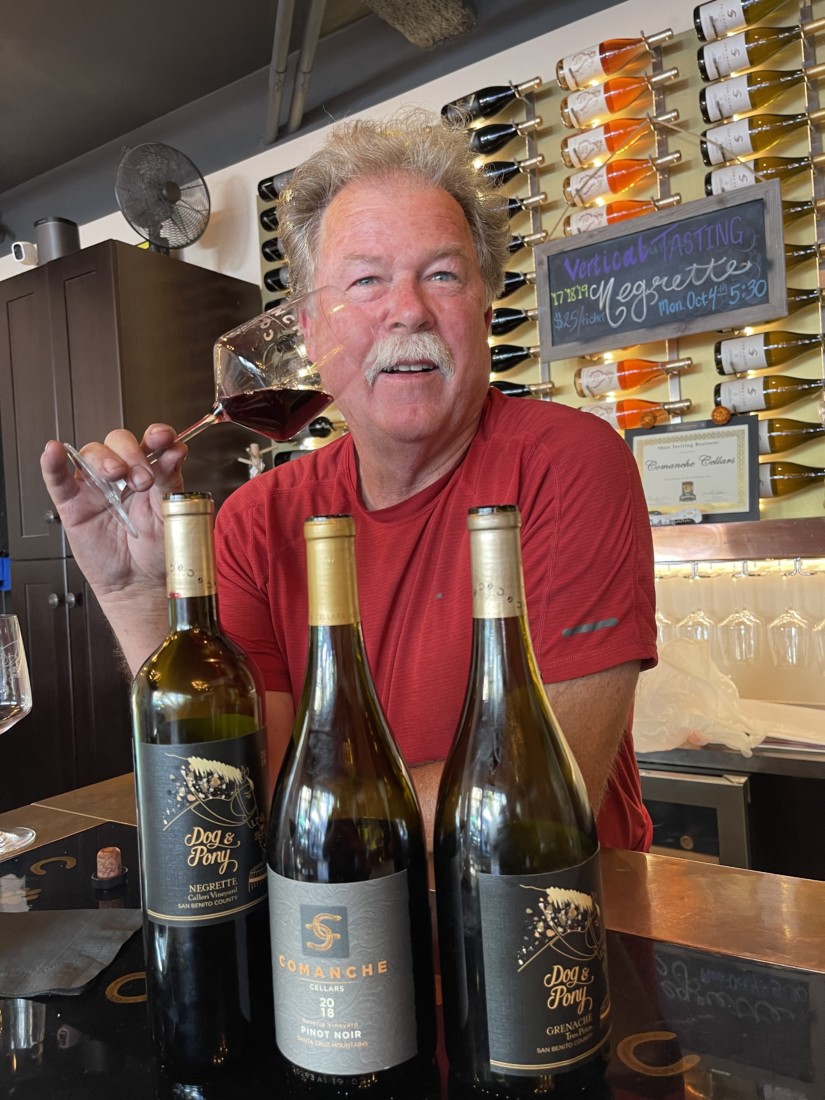
One feature of the tasting room is the monthly vertical tastings which are held on the first Monday of each month that allow guests to delve deeper into the world of a particular varietal. Last month highlighted the winery’s negrettes and the upcoming tasting, on Nov.1 will draw from their pinot noirs.
A good part of Comanche’s business comes from their wine club, which has about 300 members. Wines are released three times a year and reflect the diversity of Comanche’s list.
“We like to switch up the wines every shipment so they are all different,” Cohen said. “And we never ship two of the same bottles. We are always giving you new stuff and that’s how we stand out from everyone else.”
I had a chance to sit with Simons and Cohen, tasting wine and watching passersby shop at the thriving street market in front of their tasting room.
The Wines of Comanche Cellars
2019 Pet Gnat Pétillant Naturel Rosé 12.5% ($32) – With all due respect to “Gigi” and Maurice Chevalier, the “night they invented champagne” was around one hundred years after the first sparkling wines were produced using a process called Pétillant Naturel, in which the grapes undergo only one fermentation and no dosage (sugar) is added to aid carbonation. The result has a rich, yeasty aroma with a taste that is more subdued than champagne in some ways: a bit less sweet, a bit less carbonation, and more of the fruit flavor coming through, making it a great alternative to the cloying proseccos that are suddenly everywhere. The wine, sourced from Siletto Family Vineyard, is dry, but with a bit of watermelon and has ample fresh strawberry notes.
2020 Comanche Chardonnay 11.8% ($34) – This wine is for people who like chardonnays with a rich French oaky flavor that would work as a good food wine. I caught a hint of acidic pinot grigio and a layer of dark caramel that melted into a well-bodied creaminess with a delicate and short finish, leaving your mouth ready for the next sip. This is a luscious chardonnay, resisting the urge to emphasize any one note too strongly.
2020 Acacia Chardonnay 11.8% ($32) – “Michael has always done his chardonnays in French oak,” Cohen said. “Last year he was given some French Acacia wood barrels to try and it proved to be very popular with our customers.” The aroma is light and bright with lots of fruit. The taste is well balanced with a subtle butteriness, some Meyer lemon, and overall softness. Both of the chardonnays are made with grapes from Siletto Family Vineyard and are hard to choose between, but the Acacia is my favorite here.
2020 Dog & Pony Rosé of Sangiovese 12.1% ($28) – The grapes come from Gemelli vineyard in the Cienega Valley and this is Comanche’s first year for a Sangiovese rosé. The color is much lighter than a traditional rosé, by intent. “We picked out in the vineyard and went right into pressing the grapes,” Simons said. “No time on the skins whatsoever. You think that it is light-colored so there is nothing in there, but this one has all the flavor and all the fruit.” The fruit comes through in the brilliant fruit aroma and with a delicate taste of fuchsia, cherry, and strawberry, this is more of a wine to drink on its own rather than with food.
2018 Comanche Pinot Noir 14.14% ($42) – Sourced from the Tondre Grapefield in the Santa Lucia Highlands. “We give our pinots a lot of time in the barrel,” Simons said. “We want the fruit to taste riper and I think this wine has a lot to give.” The aroma bursts out of the glass with abundant fruit and the fruitiness carries over to the taste of thof this medium-bodied wine. The tannins are subdued and balanced against a smoky black cherry and raspberry flavor.
2018 Dog & Pony San Benito County Negrette 12.7% ($35) – Negrette is one of the oldest French grapes in the county, with vines dating back to 1855 that are still producing for DeRose Winery. San Benito County grows about 5% of the world’s production, with the rest being grown in the south of France. Sourced from Siletto, this negrette is aged 26 months in 50% new French oak and only 72 cases are produced. This is a full-fruit wine with an inviting aroma and a wonderfully bright body finishing with a bit of spice and a touch of tannin. Overall, the acidity and tannins are low allowing the Old World depth and style to come through. This is a remarkable wine all around.
2018 Dog & Pony San Benito County Grenache 12.7% ($32) – Grenache is one of my favorites and this one does not disappoint. This has some of the same characteristics as the Negrette but it has a bit more spiciness and a bit more sweetness. The aroma is very subtle and underplayed with a touch of caramel or toffee. Very smooth and full of fruit, it’s not as stately or refined as the pinots and cabernets, but it has such an appealing lightness and engaging flavor that I would drink this just because it’s a fun wine to drink and could be served with anything. Like the negrette, this is aged 26 months in 50% new French oak and only 72 cases are produced. Sourced from Siletto, this was my pick of all the Comanche Cellars wines I tried.
We need your help. Support local, independent news. BenitoLink is a nonprofit news website that reports on San Benito County. Our team is committed to this community and providing essential, accurate information to our fellow residents. It is expensive to produce local news and community support is what keeps the news flowing. Please consider supporting BenitoLink, San Benito County’s news.
You must be logged in to post a comment.