

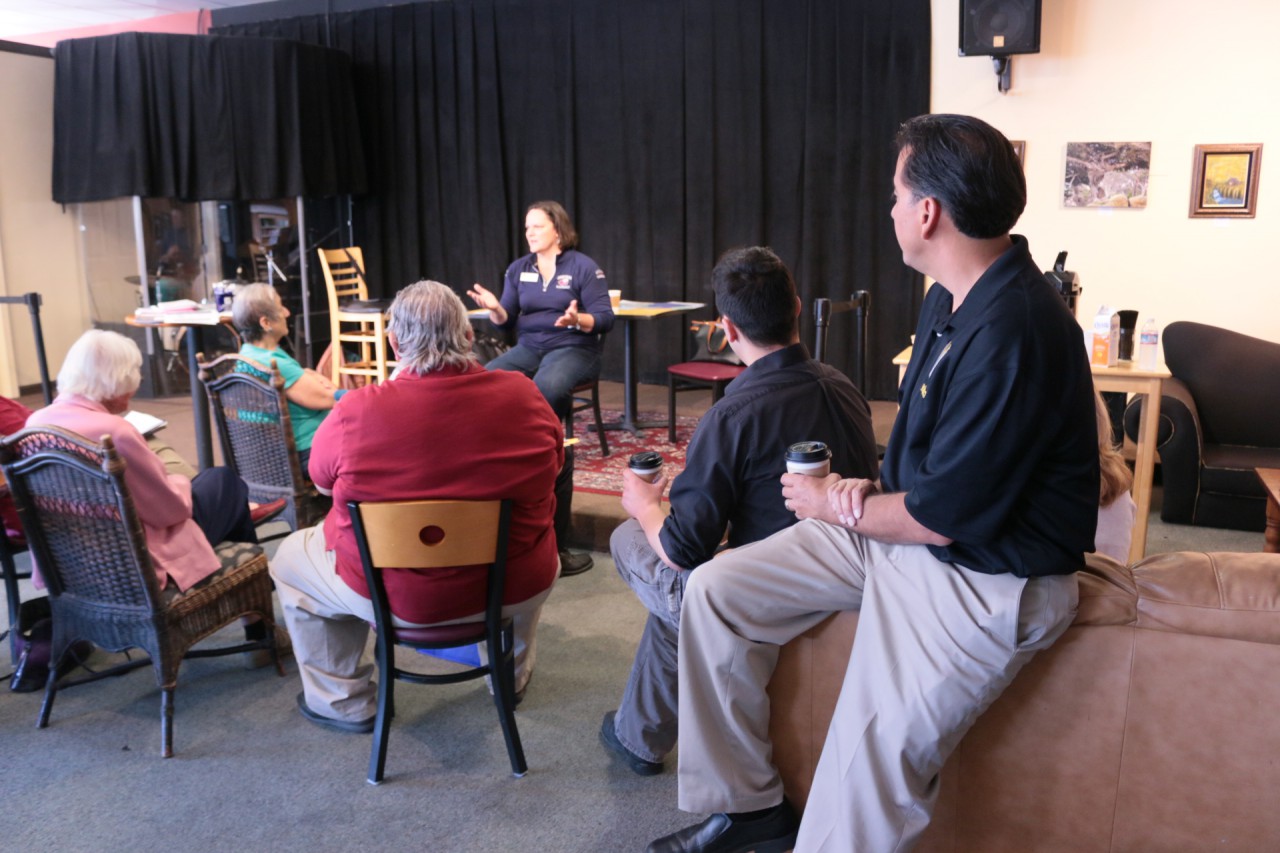
Dr. Kathleen Rose, superintendent and president of Gavilan Community College, spoke with a number of concerned Hollister residents on Saturday, July 23 at Mars Hill Coffeehouse, where she hosted the first “coffee and conversation” event concerning the college’s future in the area. Other events will follow in Morgan Hill, Aug. 3, at GVA Café, and Gilroy at First Street Coffee, Aug. 20.
As those who came to hear her mingled and sipped coffee, she made her way from one person or group to another, listening to their concerns. At the top of at least two attendee’s—Marty Richman’s and Aurelio Zuniga’s—minds was the Measure E bond that was voted on by residents with a promise, or so they thought, that Gavilan would build a campus in Hollister. Both men were polite, but the resentment lingered just below the surface that, as they saw it, laws were broken and $26 million was diverted from San Benito County to Coyote Valley.
Rose said that since she has only been president since June 1, she has been doing her homework by reading source materials for Measure E, as well as minutes of meetings, legal papers and other documents.
“My conclusion is when I read the Measure E documents, they indicate that the college promised to look at land purchases in Coyote Valley and the City of Hollister,” she said, “and the development of a university center, with the ongoing conversations with the state chancellor’s office for matching state funds to continue to build campus locations at both sites.”
Rose went on to say that because of barriers to matching state funds that are linked into the formula of enrollment growth and revenue, in additional to environmental issues, have prevented the college from coming to a final decision about “bricks and mortar” on the 80 acres, at the corner of Fairview Road and Airline Highway, that the college purchased with $12 million from the Measure E funds.
“The college has looked at 16 alternative locations in and around Hollister,” she said. “At this point, Measure E has been expended and the Coyote Valley Education site is under construction. It is part of the JPA (Joint Powers Authority) Consortium of 10 different college campuses that are contributing to public safety training for fire, sheriff and police training that will benefit everyone in the whole Central Coast and Northern California, down to the Monterey Peninsula.”
Rose said the reason that no campus has been built in San Benito County is due to a combination of factors, including environmental issues, developmental factors, the lack of state matching funds, and the inability to build a university center, which was part of the original referendum language within Measure E.
“We didn’t have ongoing conversations about doing a university center and they’ve kind of went away,” she said. “No one is building university centers anymore.”
These centers, she said, are sites comprised of California State University Monterey Bay or San Jose State and community colleges that combine funding to provide baccalaureate programs so students can do two- and four-year programs. California agencies do not have combined funding that allow that, according to Rose.
The president said conversations continue between Gavilan’s board and the state chancellor’s office about what to do with the 80 acres. She said a Gavilan board subcommittee for educational sites had recently met to talk about how to move forward on the site.
“It’s one of the reasons I’m here today, to have open conversations with the community and talk about what do we do with the 80 acres,” she said. “It’s also to tell the story about our educational programming in Hollister. It’s important for the community to understand that we’ve never left the community.”
Rose said that in the brief time she has been president, she has heard that people believe Gavilan has abandoned the San Benito County community, beginning with moving the aviation program from the Hollister Airport to the Gavilan campus, and then the Measure E-funded work in San Martin.
“We’re going to be offering courses there that basically double our enrollments when we have our August opening” in the Coyote Valley she said. “We’re going to serve Hollister, Gilroy, Morgan Hill and our 2,700-square-mile service area to a greater degree than ever before. And by doing that, people are saying we abandoned Hollister. What I’m trying to tell folks in Hollister is even though we’ve been in the Briggs Building (downtown at the corner of Fourth and San Benito streets) for 20 years, we’ve always offered educational programming and transfer-level basic skills, and career technical education. We have not backed away from any conversations and we’re not leaving town.”
Any possible construction on the 80 acres across Airline Highway from Ridgemark Golf and Country Club, however, still depends on the environmental mitigation. Fred Harris, vice president of administrative services, said the college is involved in a partnership with Dividend Homes, which has plans for a project next to the planned college site, in working on the environmental documents and overall planning for the location. He said there are two permits required: one from the U.S. Fish and Wildlife Service and one from the California Department of Fish and Wildlife, which he said is what is holding up the college from being able to “break dirt.”
Harris said Dividend Homes is in the process of developing its plan for the county and that, hopefully, before the end of the year (he wasn’t sure if it was the calendar or fiscal year) can begin preparing the land for construction.
“We have to mitigate for the Tiger Salamander,” he said. “Initially, for the feds, it was the Kit fox, but that was taken out of the process because there are no Kit foxes on the site. We’ve secured the mitigation land, Mariposa Peak, a ranch at the confluence of three counties. The next process is to develop the management plan. We’re closer than we’ve ever been.”
Harris said there is no funding, at this point, to actually build a campus in San Benito County, which he said would been done in phases, with the first phase costing around $30 million. He said some dirt will be moved to level the site. He said once the college has the permit, it can work in concert with Divided Homes to build an access road off Fairview Road. He said there is a bond measure on the November ballot, the first such bond since 2006, which is being pushed by the Coalition for Adequate School Housing (CASH), a coalition of K-12 districts.
“There is the potential for matching funds in that particular bond,” he said. “But what has to happen first is we have to get something on the site, a building or educational function to get state approval for the site. The bottom line is we’ve got to go through a planning process to get this all articulated.”
Harris disagreed with Hollister Mayor Ignacio Velazquez’ estimate of some 40 years before a college campus materializes on the 80 acres.
“I think the authority to turn dirt will be within the year, and then getting money, two to four years,” Harris said, adding that there are no blueprints of what a campus might ultimately look like, but that there are some five or six configurations to choose from should the funding happen. He said whatever the campus ultimately looks like it, has to be built in stages.
“The state’s revenue models are based on enrollments,” he said. “You develop demand, then grow it. Most likely, we’d use the model we used at Coyote Valley in terms of putting some initial facilities there, which cost $30 million for land and buildings. Once we get buildings on the site, generate revenue and get state approval, then become eligible for state capital outlay dollars. Generally, for new sites, districts have to develop the first footstep. I would say it will happen in five to six years.”
You must be logged in to post a comment.