


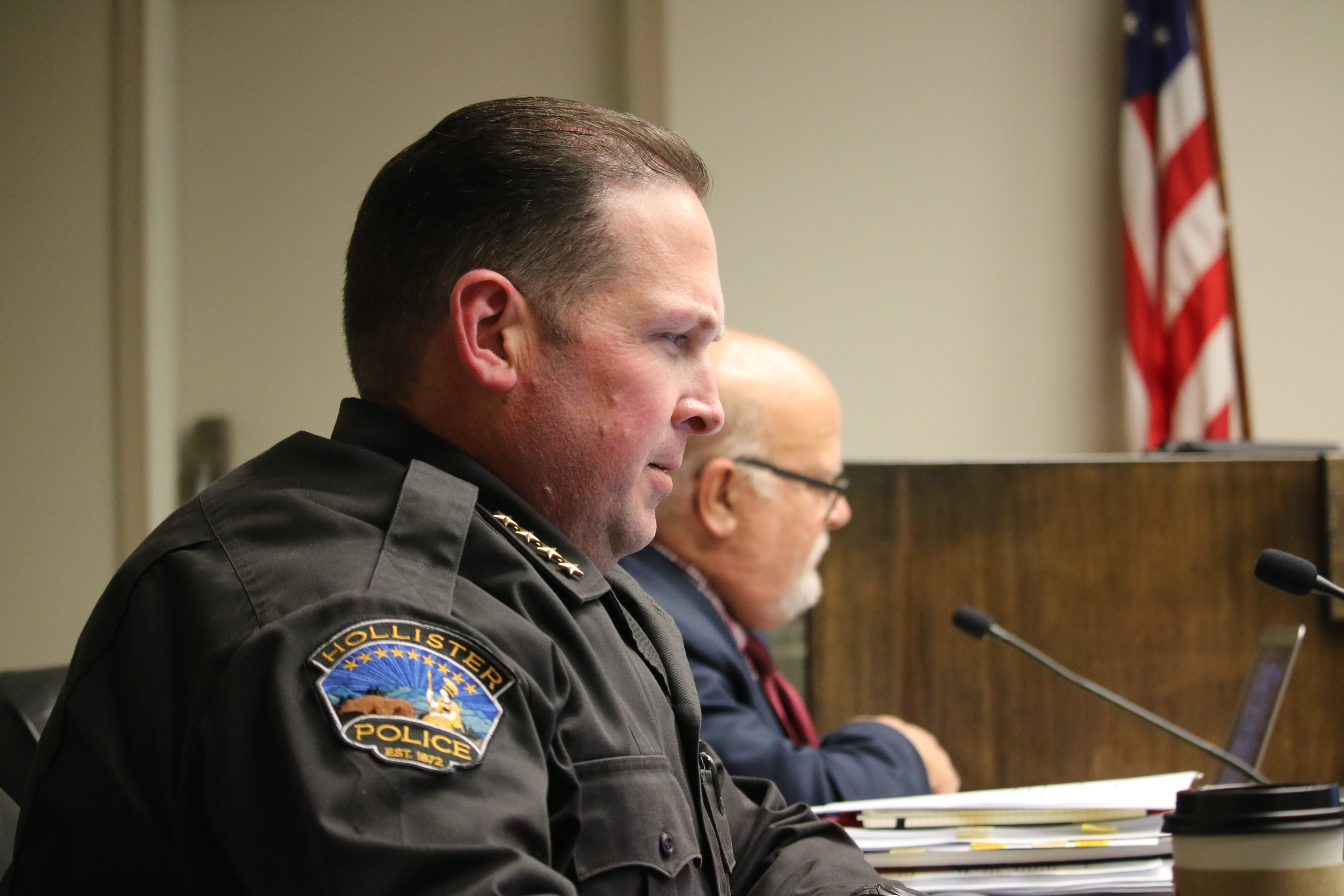
Convicted murderer Gustavo Marlow Jr. was denied parole to the relief of many who lived in Hollister in 1988, during a spree of murder, kidnappings, rape and robberies. Hollister Chief of Police, David Westrick, credits the denial to the district attorney’s dedicated efforts, as well as a concerted community letter-writing campaign.
Westrick said the parole hearing was on the hearts and minds of the whole community. He said there was a lot of fear of the unknown.
“When he was caught, convicted and sentenced there was a real relief in the community,” Westrick told BenitoLink. “When the possibility came up last summer that he may get a bid for a parole hearing and the possibility for release, we prepared internally along with the DA’s office for this case, whether it be offering direct testimony or getting letters from the community. I look at it as a community effort and the will of the people, combined with some skillful work at the district attorney’s office, to bring closure. This is the best possible outcome with the possibility of another hearing 15 years away.”
Westrick said he would have preferred that the law had not been changed but noted that he was proud of the community in stepping up and supporting the victims, as well as his department’s efforts.
“My hat’s off to the district attorney, her office for doing a fantastic job at the hearing and bringing back some closure to this community,” he said.
While Westrick credits the DA’s office, he also said the letters that the parole board saw had a great deal to do with the denial.
“We had some political people, a senator who wrote letters,” he said. “I wrote a letter and many community members wrote letters. And there were people at the hearing who were involved in the case back in the 80s. It was a good team effort.”
In February, the San Benito County Board of Supervisors approved $25,000 to support District Attorney Candice Hooper’s efforts to fight the parole of Marlow, who was convicted of two homicides and sentenced to 66 years to life. He only recently became eligible for parole after a new law, SB 260, was passed that makes it possible for juvenile offenders to be considered for parole. Marlow was just 17 and a junior at San Benito High School at the time of the killings.
Hooper said of the hearing that she attended April 7 at Sierra Conservation Center—a multi-level prison that is part firefighting training camp for inmates and a Level 3 prison, where Marlow is kept, near Jamestown—that 15 years denial was the best outcome possible under the law.
Hooper told BenitoLink that she did not know how many letters the parole board received, but only that it was a substantial amount. She described the day-long hearing as a four-phase process: phase one included the inmate’s initial offenses and prior criminal history; two studied his institutional behavior; three was support letters (he had none); four were questions from the DA to the board (if the questions were determined to be appropriate they could be asked of the inmate).
“Then they allow the victims to speak and they had 13 people speak personally or through representatives,” she said. “Their impact statements were very moving, very powerful and emotional.”
Hooper said the board came back with the denial of parole based on how horrific his crimes were and disciplinary actions against him in the prison.
“The prison system was very helpful and had reached out to the victims of our community,” Hooper said. “There was support from the county through funding so we could get our information together and present it. There was fantastic cooperation from everybody. The Hollister Police Department and the Sheriff’s Department were helpful in resurrecting their files so I would have the information to present to the board.”
One of those who sent a letter to the California Board of Parole Hearings was Assemblyman Luis A. Alejo (D-Salinas).
“Gustavo Marlow must never ever be released from prison,” Alejo said then, as reported in BenitoLink. “He has committed some of the most heinous violent crimes imaginable, and he is a proven repeat offender. We cannot ever allow this man to be free to prey on women again. To do so would be an egregious betrayal of women who put their faith in the criminal justice system to protect them from predators like Marlow. And it would be an extreme injustice to the families of the two women he murdered and to his surviving victim and her family.”
In 1995, Marlow was involved in an appeal process based on challenging DNA evidence and the methodology of collecting it. In the transcript of People vs Marlow, he contended that the trial court erred in the validity of the DNA testing due to changes in the scientific community and proper procedures were not followed. He requested an opportunity to present evidence of a change in the consensus within the scientific community. After extensive back-and-fourth arguments over the fine points of DNA testing and various scientific opinions on their validity, the scientific technique used during the trial was upheld.
Though highly technical, the concluding remarks in the transcript demonstrate the degree of scientific nuance that Marlow’s counsel went through in an attempt to win an appeal:
Defendant claims the defense experts identified a number of specific problems with Cellmark’s laboratory procedures and demonstrated how those problems infected the work done in this case. Most of these “problems” concern Cellmark’s general methodology, however, which we held in section 3, ante, to be generally accepted in the scientific community. Only a few of the “problems” deal with the specifics of this case.
The “problems” defendant has identified include: (1) Cellmark’s protocol (not “drafted in a way that any technician could follow the Cellmark procedures”); (2) buffer concentrations (possibility of too much salt could cause the DNA to migrate across the gel more slowly); (3) failure to recirculate buffer, which affects pH level; (4) unlevel gel trays; (5) failing to cool the gels in a manner leading to gel uniformity; (6) extraction procedures (do not necessarily remove all the detergent that is used to break down the cell membrane); (7) restriction enzymes (may have been stored in too high a concentration of glycerol); (8) failure to preheat kilobase markers; (9) poor quality autorads; and (10) use of ethidium bromide (which can lead to “band shifting”).
Of these, only three relate to specifics in this case. First, Dr. Lavett complained that the crime scene samples were aged and contaminated while defendant’s samples, coming from a blood sample, were sterile and clean. However, as Drs. King, Kovacs, Cotton, and Bowcock explained, where a sample is contaminated, no DNA pattern will emerge. Getting a false positive, according to these experts, is not a possibility. Here, a DNA pattern did emerge from the crime scene evidence, and that pattern matched defendant’s. Thus, contamination did not affect the results in this casse. Second, technician Tony McNeil did not keep complete notes on whether the suspect’s DNA was processed with at least 10 percent glycerol. However, as Dr. Cotton testified, McNeil followed Cellmark’s protocols in this case, and all his measurements were gone over by two Ph.D.’s. Finally, defendant complained that the gel tray used to run his sample may have been warped or tilted. However, as noted earlier, Dr. Conneally testified this issue was a red herring: “Well, you could tilt it this way and that way and every way in the world and keep tilting it for the whole number of hours that this was [run], and it wouldn’t make any difference.”
We conclude that the proper procedures were followed in this case. Accordingly, the court did not err when it admitted into evidence the DNA RFLP test results in this case.
A portion of the transcript, in much more detail, is available at: http://goo.gl/U3Rpv6

You must be logged in to post a comment.