

The closure of Planned Parenthood’s San Benito County clinic means regular trips to the health provider’s Gilroy office for two Hollister women.
But Mary Woodill and Georgianna Froom do not make the trip three days a week each Easter season and again later in the year to seek women’s medical services.
They are on a mission to stop the killing, is what they say.
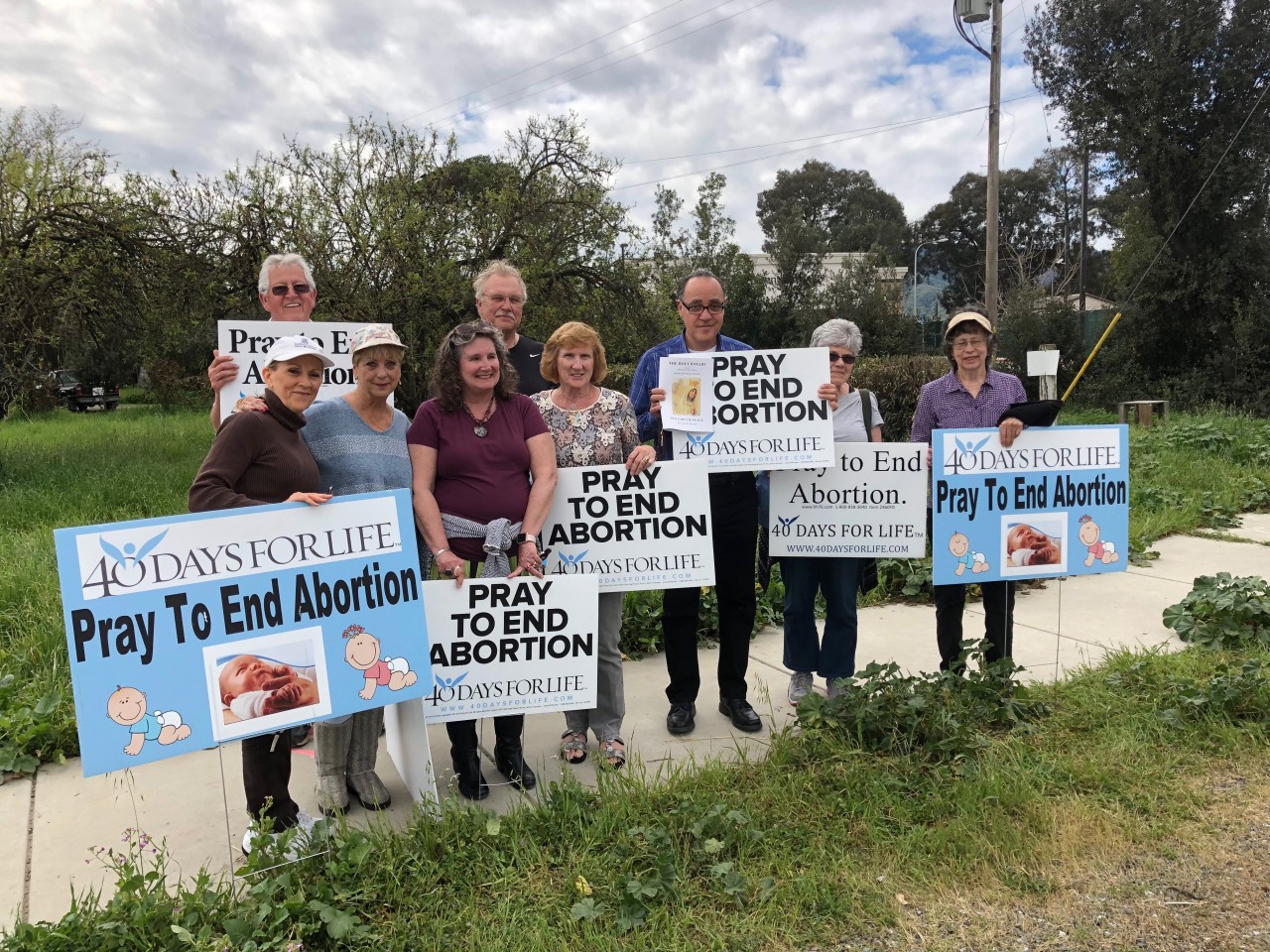
For nearly 40 days now, the pair have trekked north to stand with others at Planned Parenthood’s Renz Lane facility, holding pro-life signs and in prayer they hope will end the practice of abortion.
Although legal in every state up to a point, ending the life of an unborn child, or fetus, remains a bitterly polarizing issue here and abroad.
And so is the notion of federal funds, taxpayers’ money, being used to support the nation’s biggest abortion provider Planned Parenthood, which provides many other medical services, including to men.
Its services include birth control, cancer screening and STD tests. The controversial nonprofit bills itself as “The nation’s largest provider of sex education.”
But its abortion services are the target of both defenders and detractors in an on-going battle that pits believers in a woman’s right to choose to end a pregnancy against those who believe abortion is the taking of innocent life in its most vulnerable form and should be outlawed.
Woodill and Froom are not alone. They are part of an international, religiously based movement called 40 Days for Life. It’s a pro-life advocacy group that for more than 10 years has marshaled twice-yearly, 40-day peaceful protest vigils and fasts in the U.S. and more than 20 other countries, all aimed at ending abortion.
The current vigil began Feb. 14 and ends March 25.
“There is strength in numbers,” Froom told BenitoLink during a recent Friday walking the sidewalk in front of the Planned Parenthood Mar Monte region’s clinic in Gilroy, which is located next door to the Hollister-Gilroy office of the California Highway Patrol.
“And we are both extremely passionate about speaking out for the unborn,” Froom said.
“We pray for both the mother and the father” who are contemplating abortion, Woodill said.
The pair has been involved in the movement in Gilroy for several years, and before that they watched the Planned Parenthood office in Hollister close down after it too was the target of quiet prayer vigils in opposition to abortion.
Planned Parenthood accepts the protestors and says they are typically well behaved—if not, then action is taken.
“They are very quiet generally,” said Lupe Rodriguez, Director of Public Affairs for the health provider’s Silicon Valley/Coastal office.
“They usually have silent protests and our policy is to not engage with protesters; and we believe wholeheartedly in their right to protest.
“If they do come on the property, if they are ever blocking (clients), we will call the authorities. But for the most part we go through these cycles twice a year and typically there are no incidents or complaints.”
However, it was not 40 Days for Life demonstrators that shuttered Planned Parenthood’s only San Benito County office in 2014, she said.
“No, that is not the reason our center in Hollister closed down. We were not able to renew our lease and we were not able to find a new (Hollister) site to reopen,” she said.
Other contributing factors were the closeness of the Gilroy facility, its more robust list of services, threats of defunding by the Federal government and low, outdated state reimbursement rates for medical services to low-income clients, she said.
Ask Froom, Woodill and others, and they’ll tell you it was pressure from the pro-life demonstrations that ran Planned Parenthood out of Hollister and keeps it away.
“It helped to close their doors there,” Froom said with certainty.
John Ucovich, 82, and his wife Theresa run the day-to-day operations of their parish’s Respect for Life Committee, which among other things hosts a booth each year at the San Benito County Fair.
He has no doubt that the efforts of pro-lifers played a major role in Planned Parenthood’s decision to close down in Hollister.
“We would say the Rosary in front of that facility and it actually closed down,” he said, adding, “I strongly believe that the Spirit was working with us.”
John Karlen, director of its National Campaign for 40 Day for Life, said some landlords just don’t like the idea of having a tenant that is a lighting rod for protesters.
But the organization does not like to claim they alone close down Planned Parenthood facilities, he said. In fact closures can be the result of other issues, such as funding problems or a landlord’s dislike of having protestors show up, he said.
The organization, which had its beginning in and is headquarters in College Station/Bryan, Texas, is always quick to note the closure of an abortion provider, Karlen said, “but we are slow to claim we were the only reason.”
That said, 96 abortion facilities have shut their doors over the years in the wake of 40 Days for Life vigils, he said.
“We take that as an answer to prayer, and we are very conservative in what we consider to be a closure; if it closes then opens across town two days later, we don’t count it. Whenever we add (a facility) to the list, it is one that is closed for good.”
The current 40-day campaign involves 354 groups in 25 countries and an estimated 100,000 participants, according to Karlen.
According to the organization’s website, “Since the first coordinated 40 Days for Life campaign took place in 2007 through the end of 2017,” 5,251 local campaigns have been held in 741 cities and 47 countries with 750,000 participants from 19,000 churches. The organization claims the movement has saved in excess of 14,426 lives, has inspired 170 abortion clinic workers to quit their jobs and has seen 90 abortion facilities closed down.
For more information about the pro-life organization, go to: 40daysforlife.com
For more information about Planned Parenthood services, go to: wwww.plannedparenthood.org
You must be logged in to post a comment.