




La historia puede ser traducida en Español. BenitoLink ofrece la opcion de ‘Google Translate’ que esta localizada en el lado derecho de la pagina.
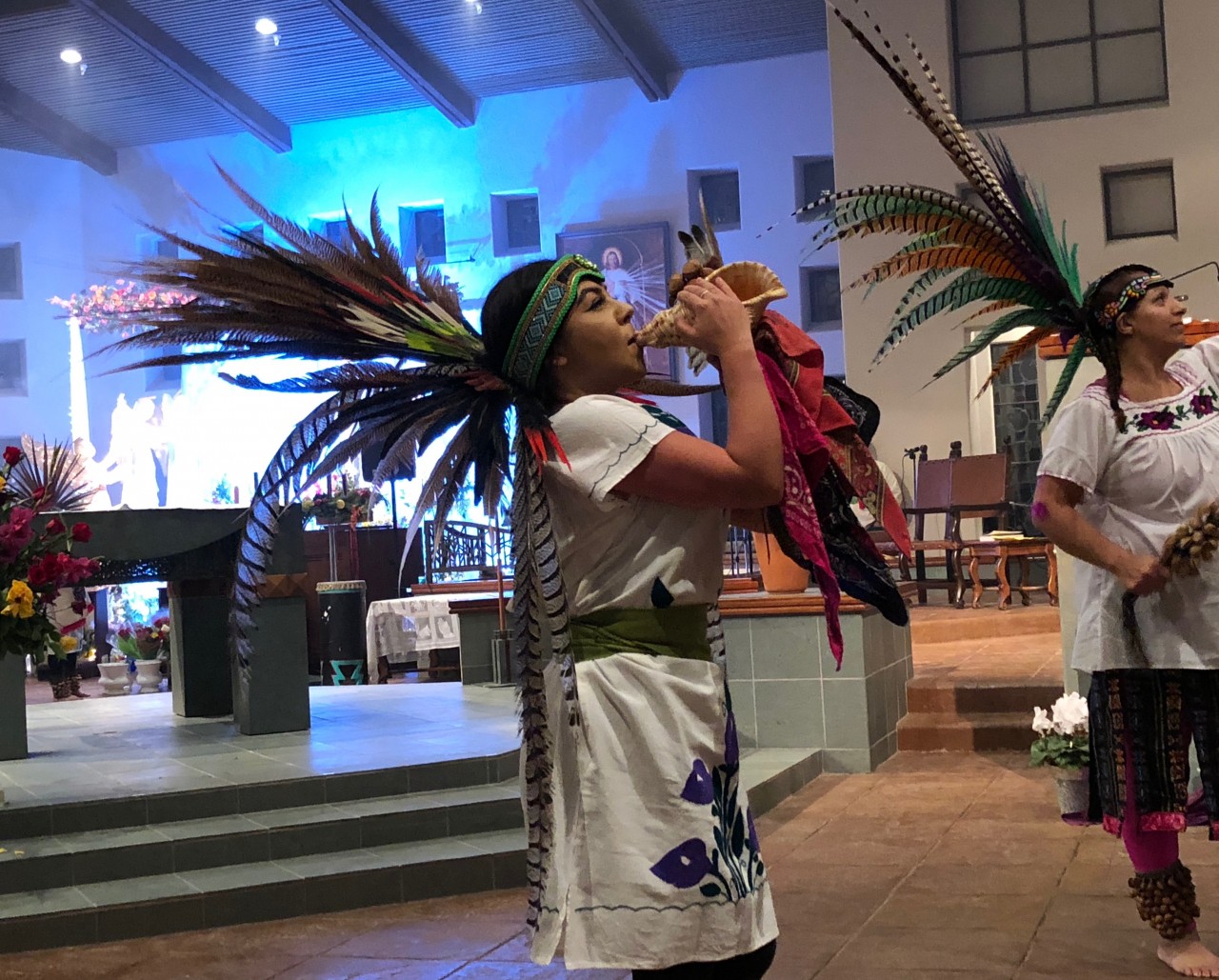
Community members gathered for the annual feast of Our Lady of Guadalupe, also known as the Virgen de Guadalupe, at St. Benedict Church on Dec. 11. The celebration spanned through the night, starting at 6:30 in the evening and ending at 7:30 the next morning. Throughout the night people brought bouquets of flowers, recited the Rosary, attended Mass, sang traditional songs and proclaimed “Que Viva La Virgen De Guadalupe!”. (Long Live Our Lady of Guadalupe!)
Attendees were treated to performances from, Los Querubines, the San Juan Pablo 11 Choir, Grupo Nauhcampa, Mariachi Misericordia, Izcalli Aztec dance group, Fernando Vasquez, Tania Pina, Banda Guanajuantense and Alma de la Vallia folklorico dance group. Food was also provided and consisted of traditional Mexican eats such as pan dulce, champurrado, ponche, tacos, and menudo.
The Virgen de Guadalupe is Mexico’s patron saint. According to folklore, she appeared to an indigenous man named Juan Diego on Dec. 9, 1531. She asked that a shrine be built on Tepeyac hill, what is now near Mexico City. Juan Diego reported her appearance to the bishop but he was not believed and asked for proof. On Dec. 12 she appeared to Juan Diego again and told him to gather roses in his cloak. Juan Diego took the roses to the bishop and when he opened his cloak, dozens of roses fell to the floor revealing her the image imprinted on the inside. The cloak is still on display today at the Basilica of Our Lady of Guadalupe in Mexico City.
While she is associated with the Catholic religion she has ultimately become a core part of Mexican identity. “Lo más grande que existe para mi. Es la madre de nosotros. La que nos cuida.” said attendee Graciela Guzmán. (She is the biggest thing that exists for me. Our Mother. The one who takes care of us.)
Her images have been used throughout history to symbolize patriotism. Miguel Hidalgo used her image when he launched his revolt against the Spanish in 1810. Emiliano Zapata also carried a banner of the Virgen de Guadalupe when he entered Mexico City in 1914. Cesar Chavez used her image during the Mexican-American civil rights movement, and by immigrants’ rights advocates in the 1990s and 2000s.
The annual feast of Our Lady of Guadalupe came to a close after 13 hours of music and entertainment, then participants headed off to work or home early the next morning.
You must be logged in to post a comment.