

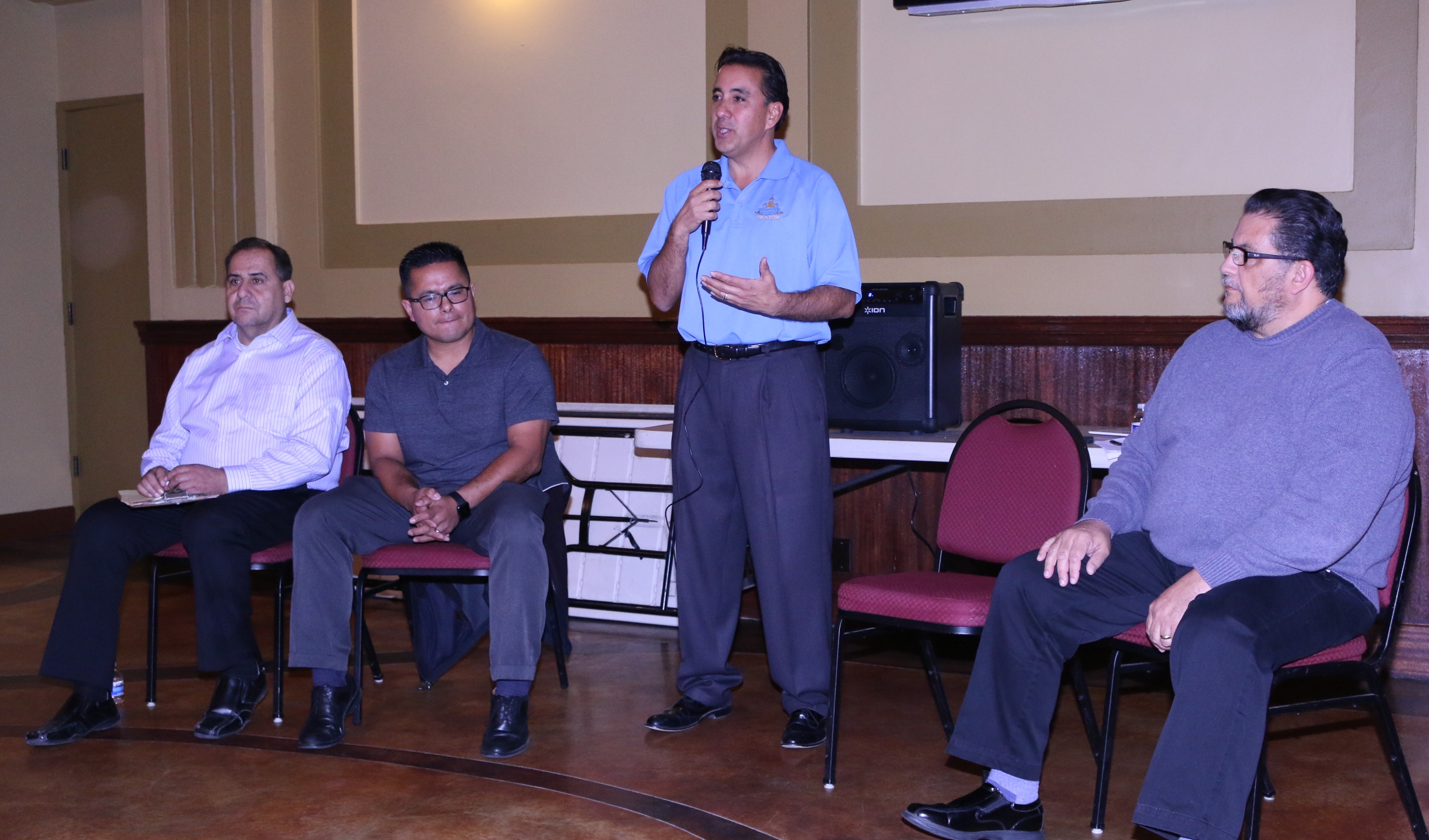

Hollister Mayor Ignacio Velazquez held his first open-forum town hall meeting Jan. 27 at The Vault, and invited a few other officials to step up and answer off-the-cuff questions from local citizens.
Alongside the mayor were County Supervisor Jamie De La Cruz, Ray Rodriguez, president of the San Benito High School Board of Trustees, and Peter Hernandez, a Hollister School District trustee. The four fielded questions for nearly two hours. Afterward, there was a presentation by the nonprofit Hollister for Aquatics Foundation. John Corrigan, president and CEO, updated the crowd on the progress of bringing an aquatic center to the city, while demonstrating how other nonprofits can work with the city and county to achieve their goals.
Velazquez recently conducted a town hall on Facebook in real-time, answering questioned posted there. He said the meeting that night would give everyone the opportunity to ask questions of himself and not only the city, but the county and school districts.
Numerous times throughout the night’s Q&A, each official was careful to say, “in my opinion,” before answering, which the mayor said they must do to be clear that they are expressing only their opinions and not those of other members of their respective boards and organizations.
“You’ll get to hear real answers, what’s going on,” the mayor said. “And how important it is for all of us to work together because if we can’t figure that part out, we’re going to have problems.”
Velazquez introduced City Councilman Ray Friend, who was sitting among the crowd and not participating in the Q&A. He told the group that Friend has played an extensive role in supporting a vision for the city for the last two years.
The mayor primed the rhetorical pump by listing a number of issues open for discussion: roads, schools, the economy and housing. He posed the first question by taking a very unscientific poll, by asking for a show of hands of those who thought there were too many homes under construction, too little, or just enough. There was no overwhelming consensus.
“This is a very big topic,” he said, echoing a frequent cautionary theme that he is in favor of slowing the growth of new home construction in favor of bringing more businesses to town. “This is probably one of the most important years our community is going to face for a long time. If we do it right, this year, and by ‘this year’ I mean the upcoming election cycle, we can get all the things that we’ve wanted. If we blow it, no more complaining and accept who we are and what we have.”
Velazquez said what is needed is for the public to come out and understand what the issues are and to talk to their friends to head off misinformation. He emphasized repeatedly the need for partnerships and said one group was missing from the meeting: Gavilan College trustees.
“I think all of us are frustrated by what’s going on,” he said. He reminded the audience that citizens passed Measure E in 2004 that everyone thought was supposed to pay for new campus in Hollister. “Every year you pay property taxes. They took that money and they’re building new facilities. The problem is, they’re in Morgan Hill. We are extremely frustrated because we want to make sure our community is educated. Eighteen percent of our population has a bachelor’s degree. In Silicon Valley and San Jose it’s 45 percent. It’s critical that we bring higher education.”
He spoke of recent cooperation between the city, the county, school district and high school to make things happen, but said the public needs to be involved too.
Supervisor De La Cruz introduced himself and reminded everyone that his district includes the city. He commented on the mayor’s mention of Measure E, saying that he was a college trustee when it was passed and he thought the money would be used to build a “full-blown” Gavilan College on the west side of Hollister.
“That’s where the services are needed, not at Ridgemark (Gavilan purchased in a joint-venture with residential builder, Dividend Homes, Inc. in 2008 the property across from the golf and country club on Airline Highway),” he said. “When I got voted to the county board of supervisors, my ideas were put aside, new trustees came in and I don’t know what happened since then.”
De La Cruz said he was excited that new partnerships were being demonstrated by the presence of the four representatives. He gave one example of the need for partnerships by pointing out the board of supervisors can do little about the school district. He said the days of fiercely holding on to jurisdictions are over.
“Today we need leaders who are willing to work together for the betterment of the community, so I’m excited because you’re here today, so we can listen to you guys and hope that this is the beginning step so we can go back to our respective bodies and say the public wants this,” he said.
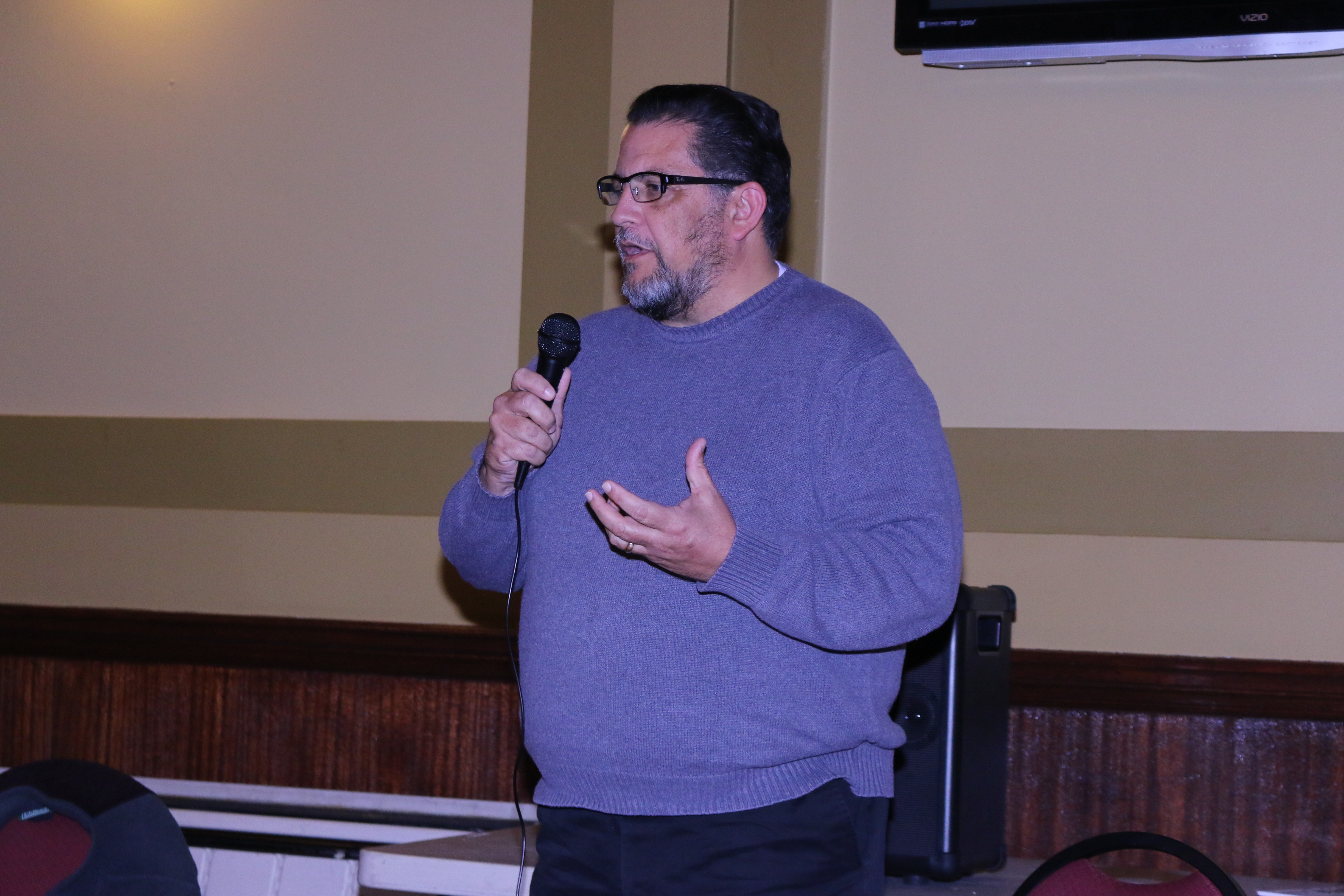
Rodriguez said communities work when the entire community buys into the schools. He said there have been discussions about new libraries, tennis courts and swimming pools that the schools cannot accomplish alone. He said he hoped that someone would ask a question about education standards, in particular, Common Core.
“This was the first year and I think we’ve been a little unfairly bashed because people didn’t like our test scores,” he said. “You have to understand, if you compare us against the state we look a lot better because it was arbitrary levels. No one had taken the test before, so they said this is below standards and this exceeds standards. The state has admitted that once the test has taken place two or three years they’ll recalibrate where the level is. If you’re going to talk about test scores you need to calibrate against what the California averages are and we’re a lot closer.”
Rodriguez said the goal is to beat the state’s standard and not other districts. He commented that parent participation at schools drops off as their children become teens. He said high school teachers are finding it more difficult to engage with parents and joked that part of the problem is few parents understand the math and can’t help with homework or help the teacher grade papers, so parents who want to be involved often find themselves relegated to sports.
“We need to find a way to actively engage (parents) in more than just athletic booster organizations,” he said. “I want to encourage you to think of ways that you can participate at the high school level.”
Rodriguez repeated something he once heard his mother tell his wife: “Your kids need you now more than when they were in diapers,” and added, “Those kids need our community now more than when they were in kindergarten and first grade. Since we’re geographically isolated, I believe that the product of that school is most creatively going to impact this community. Unfortunately, we push our kids to college and once they do most don’t come back because there’s not that high-paying job.”
He said those students who are left behind “need to become a productive member of society and help the community grow.”
Damon Felice wanted to know what was being done to keep jobs in Hollister. He said he is a fourth-generation resident who went away to college, returned and now consults for the high school, but said some locals can’t get jobs because people are hired from outside the area.
The mayor said the city should not try to compete for people who are looking for higher-paying jobs in government and leave the area to find them, but should hire people who can be trained and work their way up. Additionally, he said that when the city pays down debt, it opens up opportunities to build more infrastructure and that means more jobs. He said the city is actively attempting to attract more businesses to the area.
“This is my opinion, we need to create a system that says when a developer builds a house there needs to be a credit for a job,” Velazquez said. “Employer meet developer, buy a credit, move forward.”
Rodriguez said the high school board has decided to move away from the “traditional public contract,” toward a “lease-leaseback” contract where the district picks the main contractor for a project and leases them the land on which to build. They will do it for a maximum guaranteed price.
“A person can bid on a contract and later on back out and then you’re in court for a long time,” he said. “Now we have one contractor (from San Jose) we negotiated with and the school has set the standards. We’ve asked them to have the guys sign in every day with their ZIP codes because we ask them if they have guys who live in Hollister, let them work in Hollister. They have about 40 guys working on the site and I think 17 of them are from Hollister.”
He pointed out that the school is not only trying to assure more locals are hired for construction jobs, but it has most recently hired from within when it appointed the new principal, Adrian Ramirez, who was born and raised in Hollister.
One person wanted to know if any preference can be given to local bidders. Velazquez said in government, the project always goes to the lowest bidder and there is a need for the contractor to have a bond, which can be difficult for a local, small business. He said it can cost up to 50 percent more to do a government job than one in the private sector. De La Cruz said the county has a local preference ordinance. He explained that if there are two bids and the second-lowest bid is from a local and is within five percent of the lowest bid, the local can be awarded the contract.
He said that sometimes that even though the local company may not totally meet the request for proposal requirements and could be disqualified, the board can consider intangibles, such as if the local company gets the contract it will most likely employ more locals.
“That business is turning dollars back seven times in our community,” De La Cruz said. “So, you give that second vendor the job because, overall, the dollar savings will be maximized.”
De La Cruz said the board of supervisors needs to go to the next level by recognizing that when a developer comes to town it has often already calculated a set amount of dollars it will be willing to give the county up front, but will not admit the money is available unless someone asks. He said the board needs to grab that money to benefit the community and tell developers that if they want to come into the community they need to be creative about local jobs.
The county, he said, needs to be more aggressive about making developers “bank” local jobs, pointing out that very few dollars came back into the local community from the recent $30 million courthouse construction project. He said very few small, local companies can secure bonds and he questioned why the county can’t bond them.
Rodriguez broached the touchy subject of closing Nash Road where it runs through the San Benito High School campus during school hours. He said 11,000 kids cross the street every day, yet some people continue to fight closing it. He said there has never been much cooperation between the school, county and city, which is needed because half the school is in the city, while the other half is in the county and utilities run under the street.
“It’s a legal quagmire,” he said. “I think we’re going to work something out. The dollar figures are low, but the impact is high. It offends some people, but apparently the community cares more about tomatoes than it does their kids, because we close that cannery road day in and day out, and I know that’s a long-standing thing, but if we can throw a barrier across that road we should be able to throw a barrier across Nash and have an alternate route. I think we can move forward with that.”
Mirian Martinez and Raul Ceja made a pitch for a “pop-up” park at the 400 block lot on the corner of Fourth and San Benito streets, where the city is currently accepting bids to develop a mixed-use building. The two favor a park atmosphere that could change depending on the venue, rather than another building, citing the number of empty buildings already downtown. Martinez believed there was room for both a park and community center because, “you can always build up,” she said. Ceja challenged leaders to see public art and culture as economic drivers. He said tourists will come if they see vibrant artists, and that some of the empty retail space should be transformed into artists’ lofts.
Artist Rolan Resendez threw out a challenge to others in the room with similar artistic visions to begin networking and come up with ideas and that it is the elected officials’ responsibility to support those visions. He agreed that the 400 block should remain an open plaza.
“We need young, fresh, innovative ideas to keep up with surrounding areas,” he said. “We’re not San Francisco, we’re not San Jose, but we can make it happen here.”
Luis Burguillo said there were a number of good ideas being expressed, but said what he has seen is the city council is too quick to vote for more police and equipment, and police officers at the high school, which he contended creates an “atmosphere of fear.” He questioned why the city is spending more money on law enforcement when a recent report said crime is down. He wondered why $50,000 went to a rewards program rather than scholarships. He also asked what value has resulted from $1 million spent on cameras in downtown.
“You’re hearing from me a frustration with the city, the county and the school on not really responding to the needs of this community,” he said.
Through a burst of questions, suggestions and random conversations from the sidelines, his comments weren’t addressed.
Ellen Laitinen said all the concerns that were being shared are important.
“There are so many slices to the pie for how we reach our youth, how we envision we want them to live here, provide things for them to live here culturally and educationally, jobs, housing that one thing I’d like to suggest is appointing a point person to take on each topic to take on the discussion,” she said. “We could sit here all night talking about our slice of the pie and it would be difficult to get anywhere.”
Velazquez said, noting that he was speaking as a private citizen and not in his capacity as mayor, that the arts are incredibly important and able to change communities quickly. He told of his involvement in developing arts programs a decade before and plans for the 400 block and how the movement was defeated because some in the community felt the arts were not needed.
“We lost a decade or two because if we had done that project we would be that community that everybody wants to come visit,” he said. “We have a downtown association and we have these conversations about food trucks and restaurants because we need to light a spark that is going to change our town.”
He said it’s critically important that whatever is done to the 400 block that it be done right. He pointed toward Friend and said he highly recommended those who were interested in developing the block talk to him.
“If we do it right, this could be the center of our community,” Velazquez said. “It can change really quick in a positive way. I don’t want to see that block ruined by an office. I want to see a lot of artists, pop-up restaurants, a community could be formed there, and eventually an arts center.”
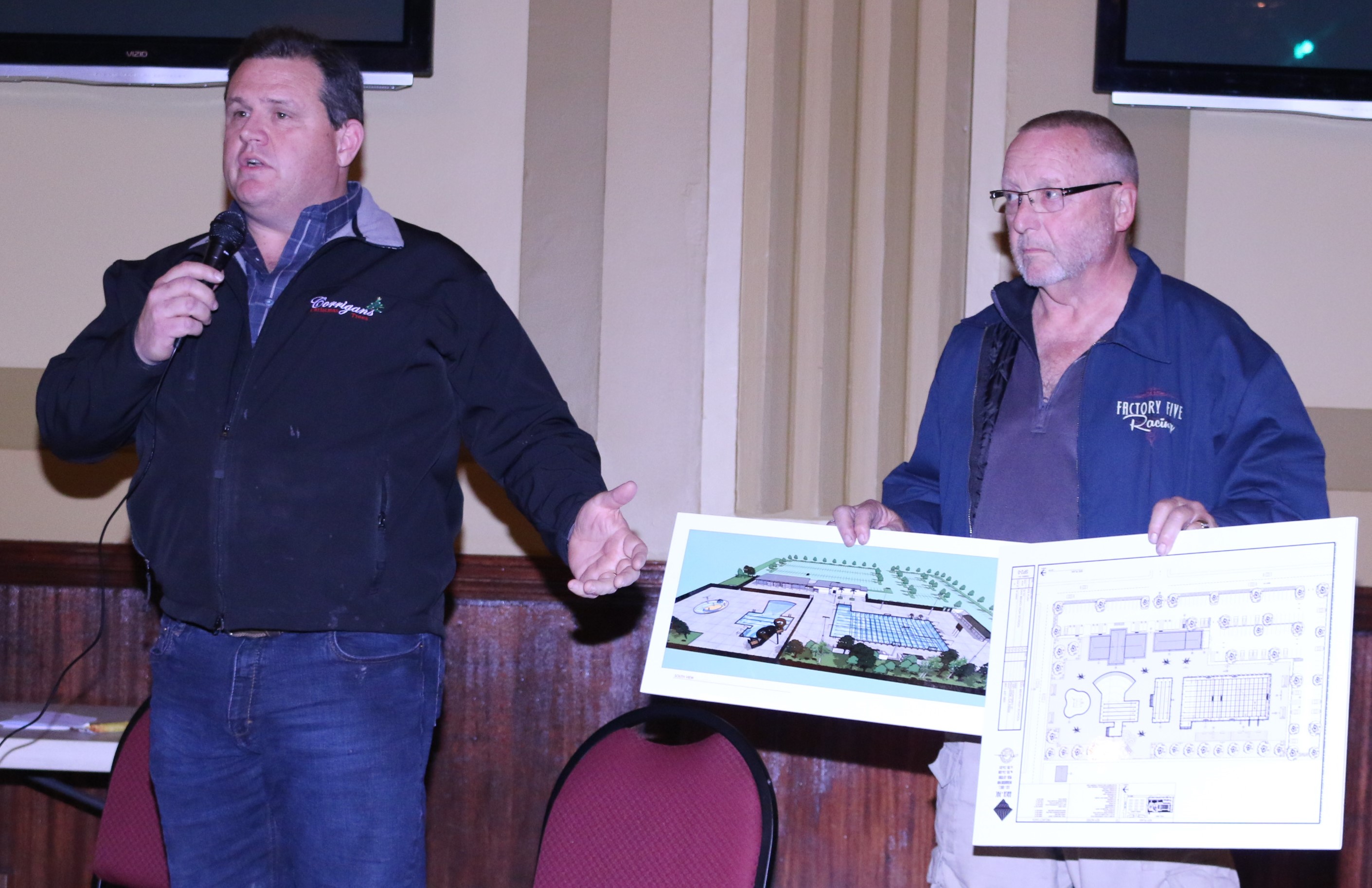
After the Q&A, Velazquez introduced John Corrigan as an example of how nonprofits should approach their projects with the best chance at success.
Corrigan was instrumental in re-opening the high school swimming pool because his own children are competitive swimmers. Now he is spearheading plans for an aquatic center that he hopes will be built on high school property.
“We’re pretty far down the path in getting a pool built for our community and our high school,” he said. “We have the support of our elected officials, but that doesn’t mean they’re going to do the work. Our nonprofit has to do the work and make it so easy for them to say, ‘yes,’ and impossible for them to say, ‘no,’ and it will happen.”
He said that if the nonprofits want Hollister to be a better place they have to make it happen and he added that there needs to be a foundation of the arts, a library and places for nonprofits to meet.
The mayor said to the group in closing: “You have a vision. You need to put it on paper, because when you present that to the council it’s different than just talking about it. It’s very important to start running some numbers so you can get the support and get moving. A council is looking at a lot of topics in one night and if you don’t have information behind your idea, it’s going to get missed. If you have information and a vision, and a rendering, everything changes.”
You must be logged in to post a comment.