

Twenty-four years ago, on Dec. 1, 1992, San Benito County and the State of California Department of Parks and Recreation Off-Highway Vehicle Division Hollister Hills District signed a memorandum of understanding (MOU) for the acquisition and development of the property now known throughout the state as one of the premier spots for off-roading, Hollister Hills State Vehicle Recreation Area (SVRA).
For eight years, the county and SVRA could not agree on terms. Then on Jan. 1, 2001, the county and SVRA came to an agreement on the pro-rata share formula to mitigate transportation impacts of the park. The board of supervisors reviewed the MOU that specified there were to be offset funds that would be placed in what was then called the Cienega Road Realignment Fund.
The agreement said the SVRA would pay the county a lump sum of $150,000, which was determined by dividing the total cost of $1.5 million to improve Cienega Road from the park entrance to Union Road, to be placed in the fund. At the time, the fund already had $543,739 in it, and with the addition of the $150,000, the total was $693,739, which the county public works staff determined was sufficient to cover improvement costs.
Additionally, the MOU stipulated that SVRA would pay the county $6,000 total or five cents per car that entered the park, whichever was greater. At the time, an estimated 40,000 vehicles a year were entering the park. Apparently, no one has recalculated the fee per vehicle since then. In any case, the county was supposed to deposit the $6,000 into the Cienega Road Realignment Fund each year. The board of supervisors was also supposed to review the MOU every two years to determine if the fee was still appropriate.
Somewhere along the line, succeeding boards of supervisors were either never told about the MOU, or everyone in county government simply forgot about it. What became obvious at the Aug. 9 board meeting was that for the past eight years, the $6,000 payments were disappearing into a bureaucratic black hole that somehow materialized as funding for the Sheriff’s Department, and no one had ever set up the Cienega Road Realignment Fund.
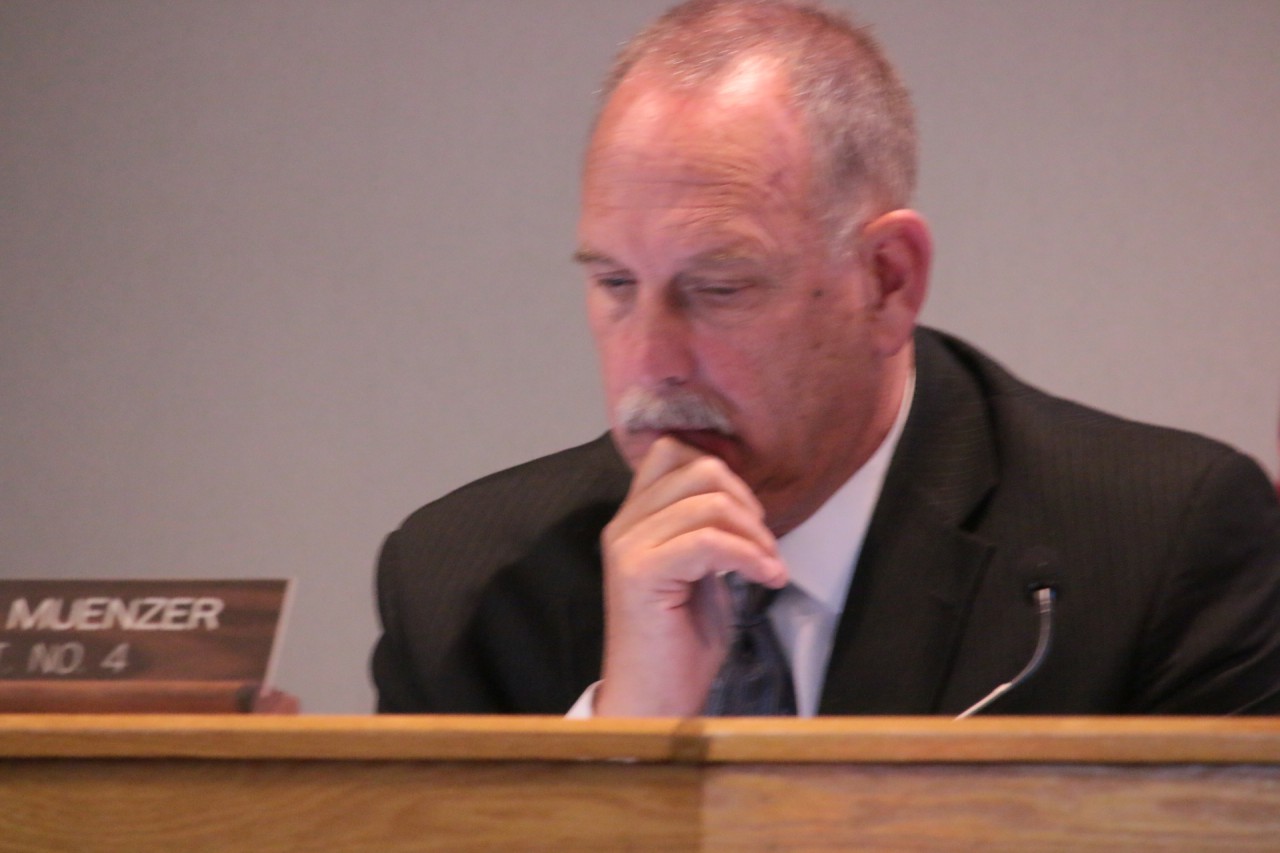
What began as a public hearing on the county budget and capital outlay budget, had its focus changed by Supervisor Jerry Muenzer just as Supervisor Richard Rivas was about to open the topic to the public for discussion.
Muenzer said it had come to light that an MOU between the county and Hollister Hills SVRA concerning a Cienega Road Maintenance Fund (his term for the fund) had been created, and money should have begun going into it during the 2008-2009 period.
According to the memorandum, of which BenitoLink secured a copy, unless following amendments changed the terms of the original MOU, the $6,000 payments should have been deposited starting back in Dec. 1, 1992 up to the date of the review, Jan. 23, 2001, and then continued to the present.
In bringing up the fund and missing payments, Muenzer asked his fellow four board members (Margie Barrios was absent) to support the idea that county staff would come back after the budget was approved with an amendment to create the fund and deposit at least eight years of payments from contingency funds into it.
“The county receives $100,000, plus or minus, from Hollister Hills each year,” he said. “That money for the last eight years has been given to the sheriff’s budget. Six thousand dollars should have been going into the Cienega Road Maintenance Fund, and it never happened. I’d like staff to tell us how we can go forward, create the fund, backfill the last eight years, and then go forward with $6,000 per year.”
Muenzer said he would also want the RMA-Public Works Department to determine how the funds would be used. (Going back to the 2001 MOU document, the county was supposed to budget for 2001-2002 an improvement project for the section of road from Union to Hospital Road.) He asked that a formal resolution be drawn up so, “this mix-up and forgetting about it doesn’t happen again.”
Supervisor Robert Rivas asked Ray Espinosa, county administrative officer, if Muenzer’s proposal was possible. Espinosa passed the question to Louie Valdez, county analyst, who said he had researched the topic, describing it as one with a “long and storied background.” He said he looked through documents back to 1999, including the original MOU and the amendment.
“Supervisor Muenzer is right,” he said. “The fund did not get created. What did happen was major work on the Cienega Road realignment project, broken up in several phases, there were monies that came in and out. Right around 2008-09, the MOU provided the $6,000 to be deposited into the Cienega Road Maintenance Fund, what may have happened, they may have forgotten about it, or mixed it up in another fund. In 2013-14 there was a $30,000 offset that went to the sheriff’s department. We cannot account how that money was spent, whether there was or was not any work done on those roads.”
Valdez said there are funds in a trust that could be deposited into a newly-created maintenance fund. Then he said they need to determine where future monies will come from — possibly the sheriff’s department — moving forward.
Whatever the vague historical account of the never-created fund and missing money, it was agreed that $48,000 would be moved from the contingency fund into a yet-to-be-created and newly renamed Cienega Road Maintenance Fund. Supervisor Jaime De La Cruz questioned, though, if it were to be a “flat $6,000,” and Muenzer said the actual wording was five cents per vehicle or $6,000, whichever was more, and that the county was supposed to count the cars going into the park, which he said should be a responsibility of the RMA director.
Espinosa said that from now on it would be the county’s responsibility to make sure the deposits went into the maintenance fund. Rivas was concerned that once the $48,000 was deposited someone might say that even more needs to be deposited. Espinosa assured him that wouldn’t happen.
“All the research we’ve done to this point, it’s $48,000,” Muenzer said.
When Rivas opened up the topic to public comments, Cathy Alameda came up with an armful of documents and seemed resigned to slog it out with the board. She introduced herself as a resident of Hidden Valley and president of its homeowners’ association. She read from a document that described Cienega Road as “un-welcoming” and continued, “many employees and cyclists traverse this dangerous route,” and it is a “pot-holed ridden course that is more hazardous than friendly.”
She referred to the 1992 MOU.
“The provisions of the MOU have not been followed by the county,” Alameda said, “leaving me to have distrust with the upcoming MOU with the sheriff’s department to return the monies that were misappropriated by the board of supervisors.”
She wanted to know what policies would be created to assure the voting public that the MOU would be upheld. She said the board’s history did not assure her that legal and fiscal responsible actions would be taken.
“What happened to the $6,000 a year from 2001 that the park paid to the county?” she asked and went on, “When will the county meet with the park service to review the traffic study and negotiate a new per-car fee based on current numbers?”
Alameda said that a recent park service study showed that more than 124,000 vehicles had entered the park in a single year. She pointed out that the MOU stipulated that the park service and county meet every two years to discuss the entrance numbers, and asked if an oversight committee had ever been formed, which was also spelled out in the MOU.
“When will a traffic study be done on Union and Nash roads to determine whether 5 percent or greater (as dictated by the 1992 MOU) of the traffic is due to Hollister Hills’ guests, which mandates repair funds for Union and Nash?” she asked. “Finally, when will the road be repaired and not just patched? I just want to say that the MOU tells you exactly what you should be doing.”
Carol Feisham said she has lived in Hidden Valley since 1997. She said people traveling to Hollister Hills, wineries and hiking trails are forced to go on a road that has not been significantly maintained in the 20 years she’s lived there.
“I appeal to you to make certain that the Cienega Road fund gets the funding it should have,” she said. “I encourage each of you to drive up there. It’s really a disgrace and you’ve got people coming from all over the state to go to these facilities that are the stone and crown for this county. They bring in money for this county, so do the right thing.”
When De La Cruz again asked Muenzer for clarification on how much Hollister Hills gives to the county, Muenzer said the park gives $100,000 every year to the county, all of which goes to the sheriff’s department, and asked that $6,000 of it go into the road fund, and that there should be traffic studies, as Alameda had asked about. Botelho said he wouldn’t try to defend why the county did not follow up with the MOU because of the number of contracts the county has, along with staffing changes over the years, and added that $6,000 would not go far in repairing roads.
“The challenges we face in this county and other counties is the lack of transportation dollars coming back from the state and federal governments,” Botelho said. “We have to put pressure not only on city councils and boards of supervisors, but state and federal legislators to get some money back to the local level so we can fix the roads. We’re spending $80 billion on a bullet train and it’s not helping a tenth of our population. This year we were faced with another state cutback of a half million dollars and that makes it more challenging. What Supervisor Muenzer is doing for his area should be commended.”
You must be logged in to post a comment.