

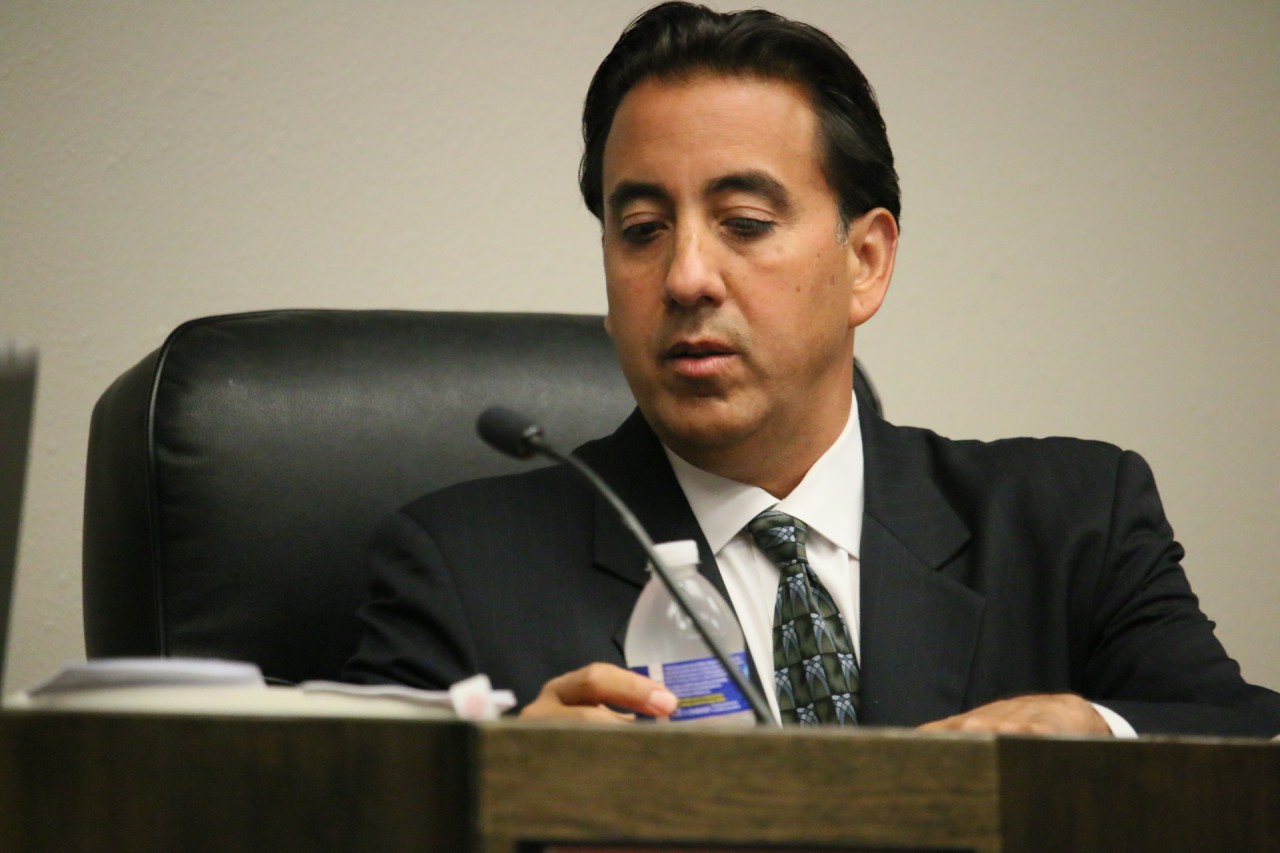

The Aug. 11 announcement from the Drug Enforcement Administration (DEA) that marijuana will remain a Schedule 1 controlled substance because it does not meet the criteria for currently accepted medical use in treatment in the United States, and because there is a lack of accepted safety for its use under medical supervision, as well as it has a high potential for abuse, did not impress Hollister City Councilman Raymond Friend.
When asked if the ruling would affect his efforts to come up with a medical marijuana ordinance for the city, he said, “They (DEA) just don’t want to deal with it because drug companies’ lobby is stronger than anybody else’s. But on the other side of the coin, I read that the Food and Drug Administration said there are some types of cancer that can be cured with marijuana.”
Friend, along with fellow councilman, Karson Klauer, has been researching a number of aspects of the medical marijuana issue as the council’s ad hoc committee. Together, and separately, they have been working to bring as much background material to the meetings as possible to construct the ordinance. They have called for a second reading of the ordinance at the Aug. 15 meeting, which means that if any of the five-member council wants to make a motion to vote on it, and three out of the five vote in favor, it could become the first medical marijuana ordinance for the city.
On Aug. 12, Mayor Ignacio Velazquez said if the proposed ordinance did come up for a vote, he would vote against it. He said he still favors putting the matter on the November ballot so the people could decide for themselves.
Velazquez, Friend and Klauer reiterated that they still wanted to gather more information. The mayor, however, was skeptical about Klauer putting the ordinance on the agenda as a “second reading,” because any of the five members could put it up for a vote. Klauer said it could be, but that a second reading did not necessarily mean a vote was a certainty.
“It can be voted on,” Klauer said. “It is the official second reading, but I don’t know if there’s going to be a vote. It just means we can vote, but we don’t have to vote. At this point, I’m not in a position to make a motion to take a vote.”
Klauer said he hopes that discussions will continue and he wants the ordinance on the agenda because he has had no direction from the entire council for two months.
“I’ve heard from many members of the public, but don’t know what the council wants to do moving forward,” he said. “I’m kind of working in a vacuum in terms of council input. We had the meeting about two weeks ago and there was no discussion between the council. I believe I need to work on some statistics. I think that’s what’s been missing through this whole process. We probably should have started with that because there have been genuine concerns that have been brought up and I don’t think I’ve been able to do a good enough job answering them.”
Klauer said he wants to ask for more city resources to do additional research because even though he and Friend have worked together on the ordinance, there has not been much “joint fact-finding,” and he feels it has not been conducive to coming up with good information.
“We’ve had a ton of public and industry input, and now I have a number of questions I need answers to before I feel comfortable doing anything,” he said. “I need to know what the council is thinking so that if we need to make any policy changes to the ordinance, the council can.”
Klauer said he wants to know what the current availability of medical marijuana is in the city. He said people may think he is changing his position, but he said that the more questions he has asked, the more he has to think about, and he realizes he doesn’t have enough answers yet.
While he said any additional public input might be helpful moving forward, Klauer said he wants to focus on independent, third-party, real-life statistics.
“I hope I can get some staff assistance,” he said. “That would be somebody from the planning department and an analyst, because the workload in association with this ordinance has been surprisingly massive, and that’s been tough to handle.”
Klauer said of the DEA announcement that people in the industry had believed that the classification for marijuana was going to be downgraded by the end of the year. He said it’s just one more thing to think about and it is his hope that the council will allow him to move into more of a fact-finding process for the next few weeks. He said that’s why, after talking to City Manager Bill Avera and discussing it with Friend, he had the ordinance placed on the agenda for more discussion and direction, and not to vote on it, as the mayor thought was being done.
Velazquez said he was told there would be a second reading of the ordinance at Monday’s council meeting and he interpreted that as a possible approval of the ordinance if there were three votes in favor of doing so. If that were the case, he restated that he would vote against it.
The mayor said of the DEA’s decision to keep marijuana a Class I controlled substance that it was more an issue to open up marijuana to more studies rather than rely on studies that had already been done, in order to determine if there were, in fact, any real medical benefits.
“That’s one item,” he said. “The second is the state approved medical marijuana 20 years ago. What we were discussing, as a city, is an ordinance for medical cannabis here, for allowing the cultivation, and allowing dispensaries locally. This is one of those issues, do we follow federal law or do we make state law? As a local government agency, do we follow state law and not federal law?”
Velazquez said if anyone objects to state laws allowing medical marijuana, they can go to the Supreme Court to attempt to overturn the state law, which he said has not happened.
“So, at this point, we’re following state law,” he said.
Velazquez said he wants to see the ordinance placed on the November ballot, but if that were not to happen, he wants more information to be gathered from the public in order to make the best decisions in crafting it.
“What are the case studies of cities that have done it,” he asked, “and was it positive or negative? What are the dollar issues as far as corruption? What do we see as far as labor wages?”
He said it is also important to remember the state is most likely going to pass legislation on recreational use of marijuana and there needs to be an understanding of local opinions on that part of the issue.
“That’s why we need to keep having these meetings before we make a decision,” Velazquez said. “I want to know the client stats on this; I want to know how banking issues are going to be handled, how security issues are going to be handled, how we’re going to prevent young people from getting it.”
Friend said he doubts if any council members are ready to recommend passing the ordinance at the upcoming meeting.
“We need to get it out in the open so all five members can talk about it,” he said. “We may have to go back and redo some areas or maybe everybody will say they’re happy with it and say, ‘let’s do it.’ I’m not hearing that, but you never know.”
Friend said he disagrees with the mayor about putting the ordinance on the ballot.
“I don’t think that’s a very good idea because it would be expensive,” he said. “We don’t have time to put it on the ballot in November, so now, all of a sudden we’re looking at having to do a special election. That could cost the city $50,000 to $60,000. I don’t know if that’s what we want to do.”
The city council will meet Monday, Aug. 15 at 6:30 p.m.
Calls to council members Victor Gomez and Mickie Luna were not returned as off press time.
You must be logged in to post a comment.