


Amid fields of lettuce, artichokes, and other vegetables in the Salinas Valley, a historically disenfranchised group exercised its right to vote for the very first time in September 1975. The electorate consisted of farmworkers — men and women whose newfound freedom resulted from the passage of the California Agricultural Labor Relations Act (known today as ALRA) three months earlier. On the heels of Cesar Chavez Day, March 31—a California state holiday that honor’s the legacy of the late labor leader—the public will have the opportunity to learn about this momentous event that for many was life-changing.
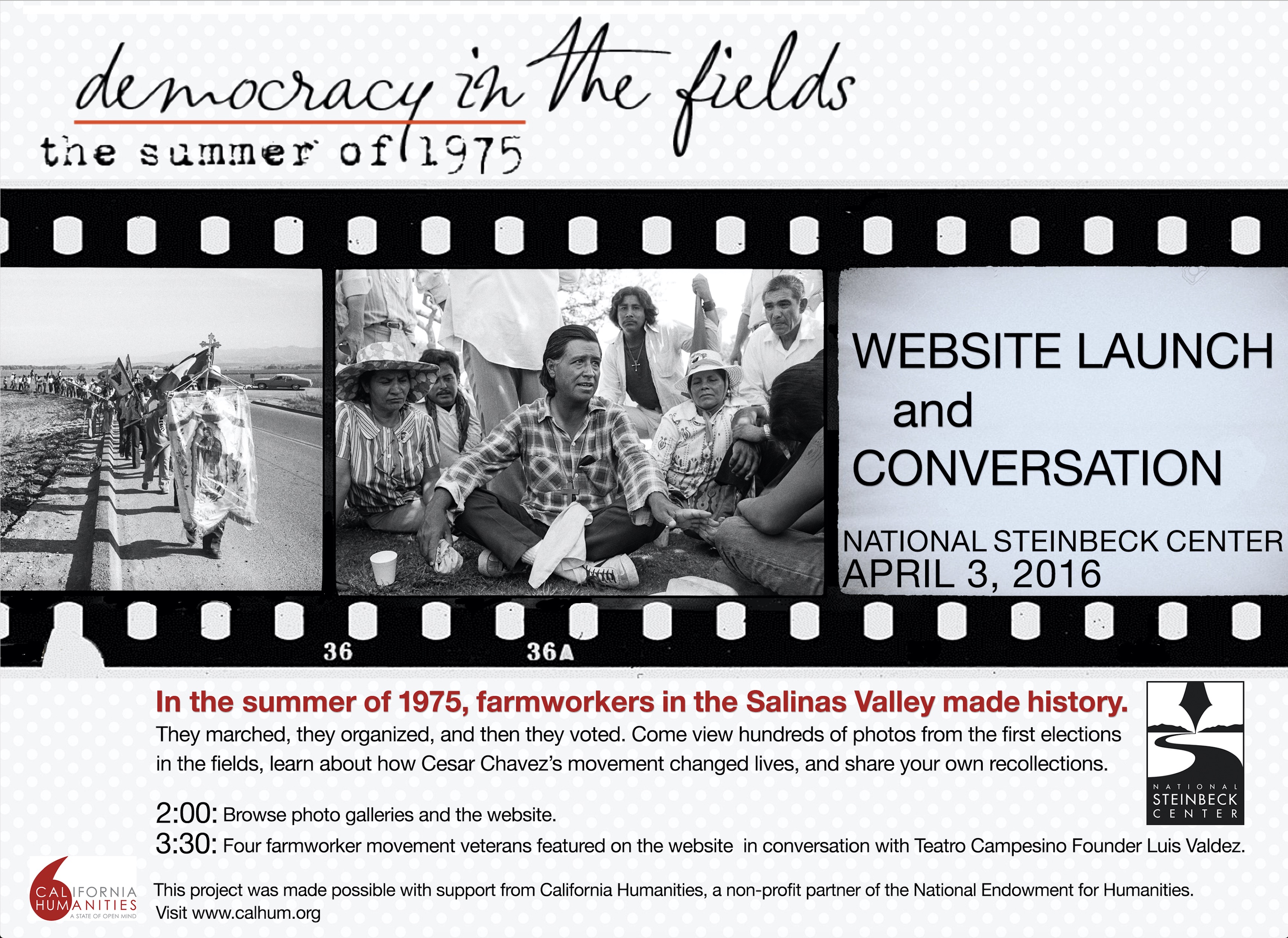
On Sunday, April 3, the National Steinbeck Center in Salinas will host the unveiling of “Democracy in the Fields,” a multi-media project [that] tells the stories of farmworkers who joined Cesar Chavez’s movement forty years ago in the Salinas Valley,” according to the center’s website.
In an interview with BenitoLink, the project’s coordinator, Miriam Pawel, explained that a collection of black and white photos by noted photographer, Mimi Plumb, served as the project’s impetus.
While studying photography in San Francisco, the then college-aged Plumb traveled down to Salinas, eager to capture scenes that would ultimately alter the Golden State’s agricultural landscape.
But unlike others who sought out farmworker leaders, such as Chavez and Dolores Huerta, Plum focused her camera elsewhere. “She was really interested in the workers. And she really documented how the union [United Farm Workers, UFW] organized during this critical period,” said Pawel.
For decades, Plumb’s photos remained stored away in a box. Only after retirement did she begin sorting through them. Realizing that only a handful of individuals were identified, Plumb contacted Pawel.
“I began recognizing people,” said Pawel, the author of “The Union of Their Dreams: Power, Hope, and Struggle in Cesar Chavez’s Farm Worker Movement” (2009) and “The Crusades of Cesar Chavez: A Biography” (2014). Pawel then reached out to others who saw familiar faces frozen in the 3-by-5-inch prints.
As identities emerged and stories unfolded, the photographer and the author decided to team-up and share this historically significant period with a broader audience.
A grant awarded through the California Humanities’ Community Stories Program, provided the project’s funding, explained Pawel. Community Stories “support story-based public humanities projects that collect, preserve, interpret, and share the stories of California communities—past and present,” according to the organization website.
Free and open to the public, Sunday’s event will begin at 2 p.m. Attendees will be able to view Plumb’s work and browse the “Democracy in the Fields” website as it goes live that afternoon.
Pawel explained the site includes three sections: “The Story,” “The People,” and “Faces.”
Divided into three chapters, “The Story” provides historical context, chronicling the events taking shape in the Salinas Valley following the passage of ALRA on June 4, 1975.
One chapter focuses on Chavez’s 1,000-mile march through California, an effort by the union organizer to inform would-be voters about the upcoming elections, while urging them to cast their ballots in favor of the UFW. And as it had done during the march from Delano to Sacramento in 1966, El Teatro Campesino (ETC) performed along la caminata, as Chavez’s trek is often called.
“The People” section features interviews with nine individuals who became involved with the UFW and describes how their lives were changed as a result of it, according to Pawel.
As many of the subjects in Plumb’s collection remain nameless, “Faces” will allow those who recognize others in the photos the platform to make on-line contributions.
At 3:30 p.m., ETC founder and long-time San Juan Bautista resident, Luis Valdez, will moderate a panel discussion with “four farmworker veterans featured on the website,” according to the event flyer.
Pawel said the conversation will move between English and Spanish and added that accommodations will be made for monolingual speakers. A translator for those who don’t understand Spanish, and “headsets for simultaneous translation from English into Spanish, for Spanish-only,” attendees.
On Sept. 5, 1975, democracy finally took root in California’s fields and orchards. The environs that calloused one’s hands and crooked one’s spine suddenly became an arena, where tens-of-thousands of empowered individuals walked taller and raised fists in solidarity with the UFW.
Liberated at last, farmworkers turned the page from their shackled past and set out to write their own future.
Learning this story, Pawel said, is important, especially for today’s youth.
She believes that “Democracy in the Fields” will help people “understand the power of a movement and the empowering sense it can have in changing lives.”
“To see that unfold should be inspiring to young people,” she added.
Free and open to the public, the April 3 the event is scheduled from 2-5 p.m. For more information, contact National Steinbeck Center at, (831) 796-3833. The center is located at 1 Main St., Salinas, 93901.
You must be logged in to post a comment.